
Resistance Band Recalls and Returns: What Actually Fails, and Why Your AQL Inspection Never Sees It Coming
Published 2026-09-18 · 14 min read · Sourcing Guide
Quick answer: every US resistance band recall we can find failed at a junction — band to handle, band to cloth loop, band to door anchor — never in the middle of the band. Those four recalls pulled 234,300 units on the strength of 28 total incident reports, about 1 in 8,400 units. An AQL 2.5 pre-shipment inspection happily accepts a lot that is genuinely 3% defective. The two numbers are roughly 286× apart, which means your inspection report is not, and cannot be, a recall risk assessment.
We extrude TPE resistance bands in Danyang, Jiangsu, on six lines producing 30 million+ bands a year. We supply a lot of loop bands, and we supply tube sets where the elastic has to be joined to a handle. The second category is the one that keeps compliance people awake, and after reading the full recall record for this category we think it deserves more attention than it gets.
This guide is not about how bands wear out in use — we covered that in why resistance bands snap. This one is about the small number of units that fail in a way that ends a listing, and about the reporting duty that attaches the moment you find out.
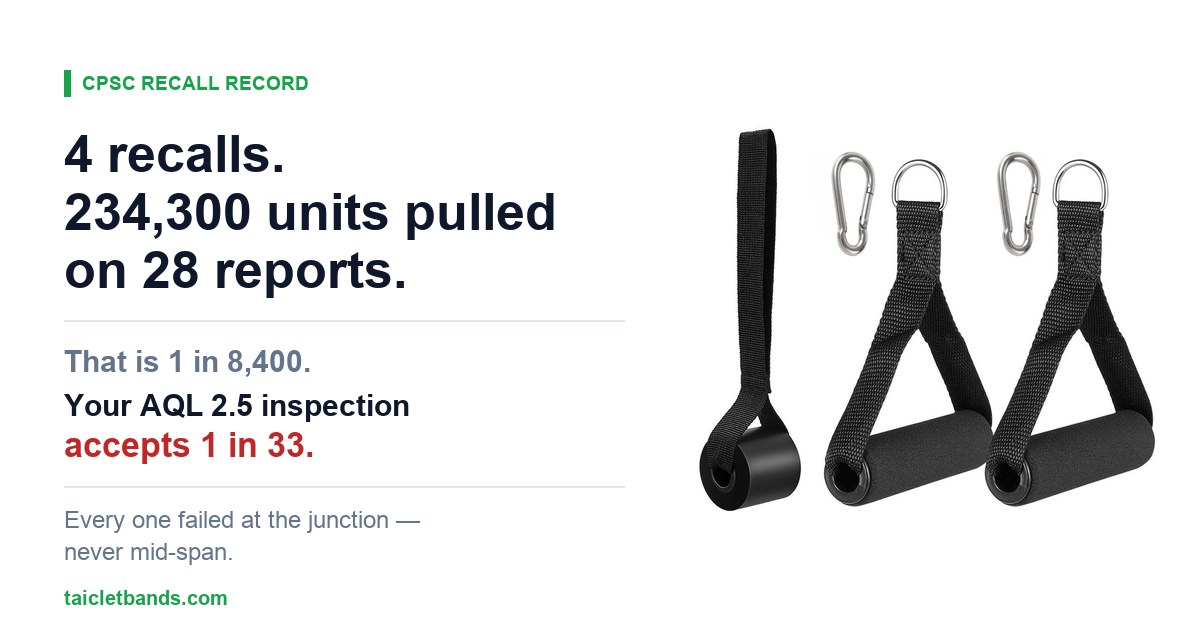
Four Recalls, One Failure Point
Here is the complete picture from CPSC recall notices. Read down the "what failed" column before anything else.
| Recall | Units | What failed | Reports |
|---|---|---|---|
| Implus Footcare, Perfect Fitness Jan 2013 · 13-100 | 75,600 | Band detached from mesh cloth loop | 12 reports back, hand, eye |
| Bollinger Fitness Jul 2014 · 14-230 | ~63,000 60k US + 3k CA | Plastic ball released from door anchor | 1 report 1 injury |
| Fit for Life, SPRI Ultra Heavy Oct 2019 · 20-005 | 95,000 | Band separated from handle | 10 reports 6 injuries |
| HomeProGym May 2026 · 26-498 | ~700 | Band separated from handle | 5 reports 0 injuries |
Not one of these recalls was caused by the elastic tearing mid-span. That is the single most useful fact in this article, because mid-span is exactly where inspection attention goes. A tensile test on a length of tube, an elongation check, a cycle count — all of it measures the part that has never been recalled.
The 2019 SPRI recall is the instructive one for anyone selling a $10 band. Fit for Life sold roughly 95,000 units at about $10 through Walmart over eleven months. Ten incident reports, six of them with injuries described as contusions, abrasions and lacerations, was enough. Both the 2019 and 2026 recalls describe the same mechanism in near-identical language seven years apart, which tells you the industry has not solved it.
The 2026 HomeProGym recall adds a detail worth dwelling on: zero injuries were reported, and the action followed independent laboratory testing that found the handle could separate. You do not need an injured customer to end up in a recall. You need a test result.
Sourcing tube sets with handles? Ask us for our pull-off test data on the band-to-carabiner junction before you compare prices. Send us your spec →
The Arithmetic: AQL 2.5 vs the Recall Trigger
Most importers buy on an AQL clause. Very few have compared the number in that clause with the number that actually triggers a recall. They differ by more than two orders of magnitude.
Take the SPRI lot size. Under ISO 2859-1 / ANSI-ASQ Z1.4 at general inspection level II, a 95,000-unit lot maps to code letter N: a sample of 500 pieces, with an acceptance number of 21 at AQL 2.5. Run the binomial on that plan and you get the operating characteristic curve below — the probability that a lot of a given true defect rate passes your inspection anyway.
| True defect rate of the lot | Probability it passes AQL 2.5 (n=500, Ac=21) |
|---|---|
| 2.0% | 99.9% |
| 2.5% | 99.1% |
| 3.0% | 95.0% |
| 4.0% | 64.6% |
| 5.0% | 24.1% |
| 6.0% | 4.9% |
So a lot that is truly 3% defective sails through an AQL 2.5 inspection 95 times out of 100. That is not a flaw in the method — it is the method working exactly as designed. AQL answers a commercial question: at an agreed quality level, do I accept this shipment? Now put it next to the safety numbers:
| Benchmark | Rate | In plain terms |
|---|---|---|
| Lot that still passes AQL 2.5 | 3.0% | 1 in 33 |
| SPRI recall trigger | 0.0105% | 1 in 9,500 |
| Bollinger recall trigger | 0.0016% | 1 in 63,000 |
| All four recalls combined | 0.012% | 1 in 8,400 |
The gap between "passes inspection" and "gets recalled" is about 286×. An inspector drawing 500 pieces from a 95,000-unit lot to find a fault that occurs once in 9,500 units has, on average, a 5% chance of pulling even one affected piece — and that is before asking whether a visual check would recognise it. The sampling plan is not weak; it is measuring something else entirely.
None of this makes AQL inspection optional. It catches the cosmetic, dimensional and packaging problems that generate the bulk of your returns, and our AQL pre-shipment inspection checklist covers how to set it up properly. The error is treating a passed inspection as evidence about safety.
Why the Inspector Cannot Catch It Anyway
There is a second, more practical reason attachment failures survive inspection: the only honest test for attachment strength destroys the unit.
An inspector working an AQL plan is checking pieces that will then be packed and shipped. The check has to be non-destructive. You can look at a crimp, tug a handle, confirm a carabiner closes. You cannot find the unit that would have let go at 2.5× rated load without pulling it until something gives, and then you own a broken band instead of a sellable one.
So attachment strength has to be verified on a separate, deliberately sacrificed sample, drawn per batch, tested to failure, and recorded. In our experience this is almost never in the customer's specification. Buyers specify band force tolerance to within a few percent — see how to measure resistance band weight — and specify nothing at all about the joint that every recall in the category has turned on.
It also matters how the joint is made. A tube bonded or crimped into a moulded handle is a permanent junction whose strength depends on process control you cannot see from the outside, and whose failure is sudden. A band that terminates in a loop and connects through a separate carabiner is a mechanical connection that can be inspected, rated and replaced, and it fails progressively and visibly. Our own handles use nylon webbing with zinc alloy carabiners for exactly this reason, and our door anchor uses webbing and EVA foam rather than a captive plastic ball of the kind that produced the 2014 Bollinger recall. If you are specifying a tube set, the construction of the junction is a safety decision, not a cost line. More detail in our resistance tube kit guide.
The $16.875 Million Lesson from the Fitness Aisle
On 6 August 2026 CPSC published a provisionally accepted settlement with Johnson Health Tech (docket 26-C0004) carrying a civil penalty of $16,875,000. The published statutory maximum for a related series of violations is $17,150,000, so the penalty is about 98% of the cap.
The charges, as set out in the Federal Register notice, describe a sequence every importer should read carefully. Between March 2018 and October 2022 the firm received at least 874 reports of Horizon T101-05 treadmills unexpectedly accelerating, stopping or changing speed, including at least 71 reports of consumer injury. It began a root-cause investigation in September 2020 and adopted production changes in February 2021 and September 2021. It did not file a Full Report until 9 March 2022, following a request from Commission staff. The recall of approximately 192,000 treadmills was announced in October 2022.
Two details deserve emphasis. First, the firm fixed the product twice in production before reporting it. Engineering had concluded there was something to fix; the regulatory filing did not follow. A root-cause investigation is close to an admission that you hold information that reasonably supports a conclusion about a defect. Second, the firm stated that it had a compliance programme and took reasonable steps to monitor and evaluate reports. Having a programme was not the defence. Timely reporting was the obligation.
Run the rate: 874 reports across 192,000 units is 0.46%. That is roughly six and a half times below the 3.0% defect rate your AQL 2.5 clause would have accepted without comment. A field failure rate well inside what your inspection regime tolerates cost $16.875 million.
This is not an isolated posture. In March 2026 Shimano agreed to an $11.5 million penalty over Hollowtech II cranksets, after receiving, per CPSC, thousands of warranty claims between 2013 and 2022 and dozens of injury reports. In both cases the charge was late reporting, not making a bad product. Neither firm admitted liability, and both settlements say so explicitly.
One more piece of timing worth knowing. Unlike agencies that adjust penalties annually, CPSC republishes its maximum civil penalty schedule on 1 December of every fifth calendar year under the CPSIA. The last notice was published 1 December 2021, setting $120,000 per violation and $17,150,000 for a related series. That makes 1 December 2026 the next scheduled republication date, and as of this writing no 2026 notice has appeared in the Federal Register. If you are budgeting compliance risk into next year, the ceiling is due to move.
No Standard Covers the Joint That Fails
Here is the structural problem underneath all of this. The international safety standard for training equipment is ISO 20957-1, currently in its third edition dated November 2024. Its clause 3.1 defines the subject:
"stationary training equipment: equipment that is not moved as a unit during use and either stands freely on the floor or is attached to a floor, wall, ceiling or other fixed structure"
A resistance band with handles is moved as a unit during use. It is outside the scope. The standard runs to usage classes S, I and H, stability requirements, edges and corners, entrapment, pull-in points — and none of it applies to the product in this article.
The consequence is worth stating plainly: the one fitness product category whose entire recall history consists of attachment failures has no published attachment-strength requirement. No minimum pull-off force. No standard test method. No warning-label requirement of its own. There is no number a factory can point to and no number a buyer can demand by reference.
That is not a reason to relax. It is the reason the specification has to come from the contract. Where a standard exists, compliance is a floor you can cite. Where none exists, whatever you wrote in the PO is the standard, and if you wrote nothing, the standard is whatever the factory happened to do that month. We hit the same structural gap on shelf life, where the nearest applicable document turned out to belong to a different industry — see resistance band shelf life and ISO 2230.
Note that being outside ISO 20957 does not put you outside regulation. CPSIA, Proposition 65 and REACH still apply, and if the band is a children's product a CPC is still required. Those are covered in our compliance and certificates guide. The gap is specifically mechanical safety performance.
Your Returns Data Is a Legal Instrument
If AQL cannot predict it and no standard defines it, what early warning do you actually have? One thing: what comes back. And most importers treat that data as an accounting problem.
On Amazon it is certainly an accounting problem first. Sports and Outdoors carries a returns processing fee threshold of 8.7%; exceed it on the trailing three-month calculation and you pay a per-unit fee on the excess returns, which for a large standard item in the 1.5–1.75 lb band runs about $4.32 per unit on the January 2026 rate card. But the processing fee is the smallest line in the stack.
| Cost line on a returned band set | Who absorbs it |
|---|---|
| Refund of the sale price | You |
| Original outbound fulfilment fee | You (not returned) |
| Refund administration on the referral fee | You |
| Returns processing fee above 8.7% | You, per excess unit |
| The unit itself — used elastic rarely goes back to sellable | You, at full COGS |
| The review that came with it | You, indefinitely |
Now the part that changes how you should file it. Under Section 15(b), the duty to report is triggered by information, and consumer complaints, warranty claims and return reason codes are information. That is precisely what the Johnson Health Tech and Shimano matters turned on: reports accumulated in a commercial system and were handled as a commercial matter.
So separate your returns into two streams, because they are different objects:
- Expectation returns — wrong resistance level, band shorter than expected, colour not as pictured, did not suit the exercise. These are a listing, labelling and packaging problem, and they are the majority. Fix them with a clearer size chart, honest force values and better inserts; our size guide and colour code chart exist because this is where most returns come from.
- Failure returns — it broke, it came apart, it hit me. These are a safety signal even at single-digit counts, and they need a named owner, a written evaluation and a date stamp. CPSC guidance allows a reasonable evaluation period, generally not exceeding 10 days, before the clock runs out.
Any return mentioning the eye should escalate immediately regardless of count. The clinical picture explains why: the Bascom Palmer Eye Institute case series covering March to September 2020 reviewed 11 patients with 14 injured eyes from exercise band trauma. All 11 had iritis, 9 had hyphema and 4 had vitreous haemorrhage; mean presenting acuity was about 20/100, and although the average improved to roughly 20/40, 4 eyes (33%) remained at 20/60 or worse at last follow-up. Permanent vision loss in a third of injured eyes is the kind of severity that makes a low-frequency defect a substantial product hazard. It is also, bluntly, the reason "only five complaints" is not a defence.
What to Actually Write Into the PO
Five clauses. None of them is expensive; all of them are things we are routinely asked for by the better buyers and almost never asked for by the rest.
- A numeric pull-off requirement for every band-to-hardware junction. Since no standard gives you one, state it yourself — a hold, for a stated duration, at a stated multiple of rated resistance, on every junction type in the set. The number matters less than its existence; a specification with a testable number in it changes what the factory tools for.
- Destructive batch testing, separate from AQL. A fixed number of units per production batch pulled to failure, results recorded with the batch code, retained for the life of the product. This is the only test that looks at the failure mode the recalls are about.
- ISO 8601 date of manufacture and batch code on every inner carton. This is the difference between recalling one batch and recalling everything you have ever sold. The Bollinger recall covered about 63,000 units off one incident; scope control is the cheapest insurance in this list.
- Retention samples held at the factory from every batch. When a complaint arrives eight months later, you want a same-batch unit to test rather than an argument.
- A change-notification clause. The factory notifies you before changing a material, a supplier or a process step. A silent change is how a product that passed everything becomes a different product — and, per the Johnson Health Tech chronology, a production change made in response to field reports is itself a fact a regulator will ask about.
Add one internal clause that costs nothing: decide now, in writing, who in your company owns the decision to report, and what triggers an evaluation. Both 2026 penalty cases involved firms with functioning quality processes. What was missing was the handoff from "engineering is looking at it" to "counsel is evaluating whether this is reportable."
If you are validating a new supplier, the place to run all of this is the sample stage, before there is a container involved — see resistance band samples: how to order, test and approve.
Where This Analysis Is Weakest
Three honest limits, because a guide that claims none is not worth trusting.
The recall sample is small. Four notices is a pattern, not a statistic, and CPSC recalls are a filtered view — they show what got reported and acted on, not the true population of failures. The consistency of the failure location across thirteen years is what gives it weight, not the sample size.
Incident-to-unit ratios are not defect rates. An incident count is the number of people who bothered to tell someone, which understates true failures by an unknown factor. We use those ratios to show the order of magnitude at which regulatory action occurs, not to estimate how many units are bad.
The AQL comparison is deliberately apples-to-oranges. That is the point of it — the two numbers measure different things on different populations — but it does mean you should not read "286×" as a quality metric. It is an argument that one number cannot substitute for the other.
Frequently Asked Questions
Have resistance bands actually been recalled in the United States?
Yes, repeatedly. Implus Footcare recalled 75,600 Perfect Fitness bands in January 2013 (13-100) after bands detached from mesh cloth loops; Bollinger Fitness recalled about 63,000 units in July 2014 (14-230) after a door anchor ball released; Fit for Life recalled 95,000 SPRI Ultra Heavy bands in October 2019 (20-005) after bands separated from handles; HomeProGym recalled about 700 bands in May 2026 (26-498) for the same handle separation. In all four the failure was at a junction, not mid-span.
How many complaints does it take to trigger a resistance band recall?
Far fewer than most importers assume. Those four recalls pulled 234,300 units on 28 total incident reports — about 0.012%, or 1 in 8,400. Bollinger's roughly 63,000-unit recall followed a single reported incident. The 2026 HomeProGym recall proceeded with five reports and zero injuries, prompted by independent lab testing. Recalls are not triggered by a defect rate crossing a threshold; they are triggered by information reasonably supporting a conclusion about a substantial product hazard.
Does passing an AQL 2.5 inspection mean my bands will not be recalled?
No. Under ISO 2859-1 at level II, a 95,000-unit lot draws 500 pieces with an acceptance number of 21 at AQL 2.5, and a lot that is genuinely 3.0% defective still passes about 95% of the time. The SPRI recall trigger was 0.0105%. Those are roughly 286× apart. AQL decides whether to accept a shipment at an agreed quality level; it was never designed to detect low-frequency safety failures and cannot.
Is there an international safety standard for resistance bands?
Not one that covers them. ISO 20957-1:2024 clause 3.1 defines stationary training equipment as equipment "not moved as a unit during use" that stands freely on the floor or attaches to a fixed structure. A band with handles is moved as a unit, so it falls outside scope. The category whose whole recall record is attachment failures therefore has no published attachment-strength requirement and no standard test method. Any pull test in your spec is one you wrote yourself.
What is the CPSC 24-hour reporting rule, and does it apply to importers?
Section 15(b) of the CPSA requires manufacturers, importers, distributors and retailers to notify CPSC immediately on obtaining information that reasonably supports the conclusion that a product contains a defect that could create a substantial product hazard or an unreasonable risk of serious injury. CPSC reads "immediately" as within 24 hours, with a reasonable investigation period that guidance indicates should not exceed 10 days. Importers are squarely covered — if you are importer of record, the duty is yours regardless of what the factory knew.
What does late reporting actually cost?
In August 2026 CPSC provisionally accepted a settlement with Johnson Health Tech (26-C0004) carrying a $16,875,000 civil penalty — about 98% of the $17,150,000 statutory maximum for a related series. Staff charged at least 874 field reports and 71 injury reports between 2018 and 2022, a root-cause investigation opened in 2020, production changes in 2021, and no Full Report until March 2022 after staff asked. In March 2026 Shimano agreed to $11.5 million on a comparable late-reporting pattern. Neither firm admitted liability.
Why do resistance band injuries so often involve the eye?
A released band turns stored elastic energy into a fast object at about face height, and the blink reflex is too slow. In a Bascom Palmer Eye Institute case series from March–September 2020, 11 patients presented with 14 injured eyes: iritis in all 11, hyphema in 9, vitreous haemorrhage in 4. Mean presenting acuity was about 20/100, improving to roughly 20/40, but 4 eyes (33%) stayed at 20/60 or worse. That severity, not the frequency, is what drives regulatory attention and liability exposure.
What should I put in my purchase order to reduce recall risk?
Five clauses: a numeric pull-off requirement for every band-to-hardware junction; destructive per-batch testing separate from and additional to AQL, with retained results; ISO 8601 date of manufacture and batch code on every inner carton so a recall can be scoped to a batch; retention samples held at the factory per batch; and a change-notification clause covering materials, suppliers and process steps.
Related Guides
- Resistance band quality control: the AQL pre-shipment inspection checklist — how to set the plan this article says is necessary but not sufficient
- Why do resistance bands snap? — the in-use failure modes, as opposed to the recallable ones
- Resistance band compliance: CPSIA, Prop 65, REACH and GPSR
- Resistance tube kits: handles, anchors and how the junction is built
- Resistance band samples: how to order, test and approve before bulk
- Selling resistance bands on Amazon FBA — where the returns data in this guide comes from
Talk to the Factory
TAICLET is a TPE-only manufacturer in Danyang, Jiangsu — six extrusion lines, 30 million+ bands a year, no natural rubber latex in any product. If you are specifying a tube set with handles or a door anchor, send us your pull-off requirement and we will test to it and send you the data with the sample, rather than after the complaint.
Browse handle sets, mini loop bands and pull-up assist bands, or send us your requirements. OEM from 200 sets, wholesale from 1,000 sets, FOB Ningbo.
Writing a spec for a tube set? Tell us the resistance range and the junction type and we will quote with a pull-off test protocol included. Request a quote → Samples in 3–5 days on stock colours.
Sources
- CPSC recall notices 13-100, 14-230, 20-005 and 26-498 (cpsc.gov/Recalls)
- Federal Register 91 FR 50819 (6 Aug 2026), CPSC Docket 26-C0004, Johnson Health Tech settlement agreement
- CPSC, Civil Penalties; Notice of Adjusted Maximum Amounts, 1 Dec 2021
- CPSA section 15(b), 15 U.S.C. 2064(b); 16 CFR Part 1115
- ISO 20957-1:2024, Stationary training equipment — Part 1: General safety requirements and test methods, clauses 1 and 3.1
- ISO 2859-1 / ANSI-ASQ Z1.4 single sampling plans, normal inspection, general inspection level II
- Ocular trauma secondary to exercise resistance bands during the COVID-19 pandemic, American Journal of Emergency Medicine (Bascom Palmer Eye Institute case series)
- Amazon FBA returns processing fee rate card and category thresholds, January 2026