
Resistance Band Samples: How to Order, Test and Approve Them Before You Commit to Bulk
Updated 2026-09-11 · 14 min read · Sourcing
Quick answer: order three pieces per resistance level plus one to destroy, from at least two suppliers. Stock samples should be free apart from a $25-40 courier fee; custom colour or logo samples cost $50-100 and should be credited against your first order. Test them with a luggage scale at 100% elongation and a pair of calipers — the three pieces of each level should agree within 10% on force and ±0.05 mm on thickness. Then sign a pre-production sample off the actual line, not the hand-made development sample. Budget 8-12 weeks from first sample request to goods arriving.
The sample stage is the cheapest point in the whole import process to find out that a supplier is wrong for you. It is also the stage buyers rush most, because a nice-looking band arrives, feels fine in the hand, and the PO goes out the same week. We ship samples to new buyers every week, and this is the process we would want a buyer to run on us — including the tests that catch the problems a band cannot show you by looking at it.
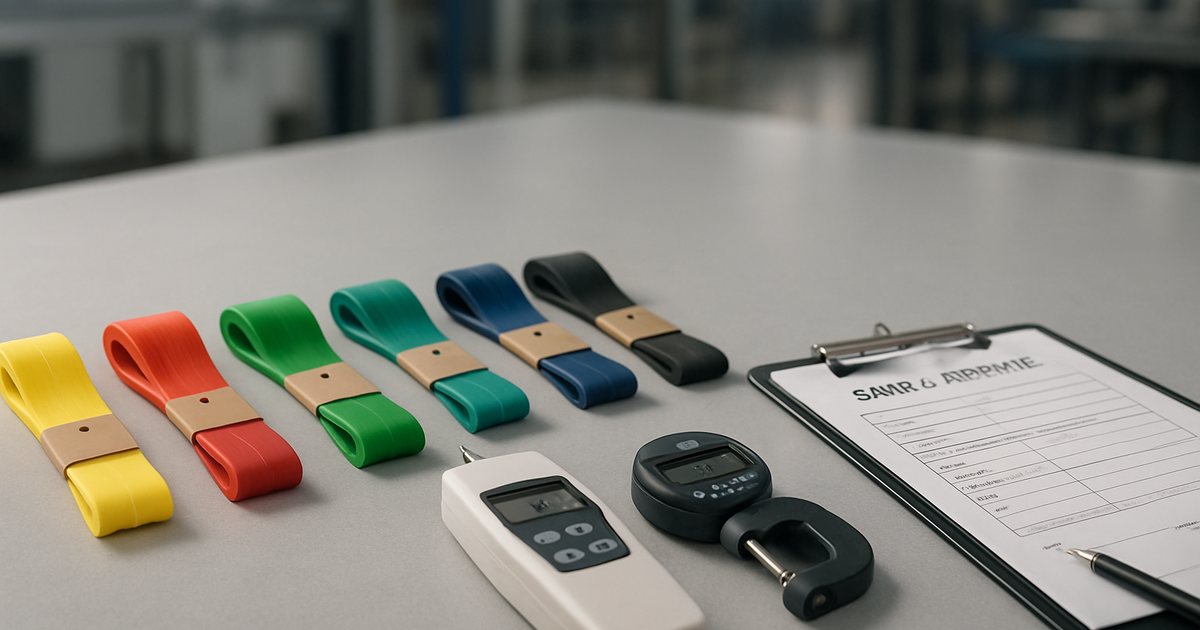
The Four Kinds of Sample (and Why Only One Gets Signed)
"Can you send a sample?" means four different things depending on where you are in the process. Mixing them up is how a buyer ends up approving one product and receiving another.
| Sample type | What it proves | Typical cost | Lead time |
|---|---|---|---|
| Stock sample | Material, feel, force range, general quality of the supplier | Free + $25-40 courier | Ships in 5-7 days |
| Custom development sample | Your Pantone colour, custom thickness or force level | $50-100, credited on first order | 7-10 working days |
| Branding sample | Logo print position, ink, adhesion; packaging artwork | Usually bundled with custom sample | 7-10 working days |
| Pre-production sample (PPS / golden sample) | That the production line can make what you approved | Included in the order | Pulled at start of production |
The first three are design decisions. The fourth is a process decision, and it is the only one that should be signed, sealed and used as the inspection reference. Why it matters: a custom colour sample for a TPE band is made from a small trial batch of compound — a few kilograms mixed on a lab or pilot line. Your order will run from a production batch of hundreds of kilograms on the main extruder. Colour, hardness and force all shift slightly between the two. A good factory corrects for that before your PPS; an average one hopes you will not notice.
How to Request Samples So the Comparison Is Actually Fair
Most buyers compare suppliers on samples that were not built to the same brief. Supplier A sends its best-selling set, supplier B sends whatever was on the shelf, and the "winner" is chosen on colour. Fix it with a one-page sample brief sent identically to every candidate:
- Product and material — e.g. "TPE mini loop band, 30 cm × 5 cm, latex-free, no recycled content".
- Resistance levels you need, stated as force at a defined stretch, not as colour names. "Extra light to extra heavy" means nothing across suppliers; "approx. 2, 4, 7, 11, 16 kg at 100% elongation" can be checked. Our resistance band color code chart shows how far brand colour conventions drift from each other.
- Quantity: three per level, plus one extra per level for destructive testing.
- A sample tag on every band stating nominal thickness, width, length and force. A supplier who cannot write the numbers on the tag has not measured them.
- Their measurement method — elongation, hold time, instrument — so you can reproduce it.
- Commercial terms in the same email: MOQ, unit price at your target volume, production lead time, whether sample fees are credited. Samples without a price are a science project, not a sourcing step.
Order from two or three suppliers at the same time. Sampling sequentially — waiting for supplier A to fail before contacting supplier B — is the single biggest reason first orders slip by a month.
Want to benchmark us? Send us the same brief you send everyone else. We ship stock TPE samples in 5-7 days with measured values on every tag, and we credit custom sample fees against your first order. Request samples →
The At-Home Test Kit: $40 of Tools That Catch Most Problems
You do not need a lab to evaluate band samples. You need three tools and an hour:
- Digital luggage scale (0-50 kg, 10 g resolution) — around $10-15. Accurate enough to compare samples and suppliers against each other, which is what this stage is for.
- Digital calipers (0.01 mm resolution) — around $15-25. A micrometer is better for thin bands, but calipers used gently at three points will show you thickness variation.
- Tape measure and a fixed anchor point — a door hinge, a squat rack upright or a hook screwed into a bench.
Run these seven checks on every level from every supplier and write the numbers into one spreadsheet.
| # | Check | How | Pass criterion |
|---|---|---|---|
| 1 | Odour and surface | Open the bag, smell, run a finger along both faces | Low odour; no tacky, oily or powdery surface; no specks |
| 2 | Dimensions | Calipers at 3 points across width and along length; tape for length | Thickness ±0.05 mm of tag; taper across width <0.03 mm; width ±1 mm |
| 3 | Force at 100% | Anchor, stretch to double resting length, read after 3 s hold | 3 samples of a level within 10% of each other and of the tag value |
| 4 | Level spacing | Compare force across the levels in a set | Each step noticeably heavier; no two adjacent levels within 15% |
| 5 | Stretch-and-hold | Stretch the extra band to 200-300%, hold 10 s, inspect edges under light | No whitening, no edge opening, no audible tearing |
| 6 | Fatigue and set | 500 stretches to 100%; rest 30 min; re-measure force and length | Force drop ≤5%; permanent length increase ≤3% |
| 7 | Print and colour | Tape pull + 50 dry rubs on the logo; colour vs your reference in daylight | No ink transfer; colour visibly matches |
Check 3 is the one that separates suppliers. Almost every sample looks good. The difference shows up when three bands sold as the same "medium" read 5.1 kg, 5.3 kg and 6.4 kg — that 25% spread is extrusion thickness variation, and it will be worse in bulk than in a sample the supplier picked by hand. The full method, including why the three-second hold matters on a viscoelastic material, is in our guide on how to measure resistance band weight.
Check 6 is the one buyers skip. A band that loses 12% of its force after 500 cycles will feel noticeably weaker to your customer within a few weeks of use. It is also the fastest way to spot reclaimed or heavily extended compound, which tests fine when new. For material-level numbers — tensile strength to ASTM D412, Shore A hardness to ASTM D2240, 10,000-cycle retention — ask the supplier for their qualification data rather than trying to replicate it at home.
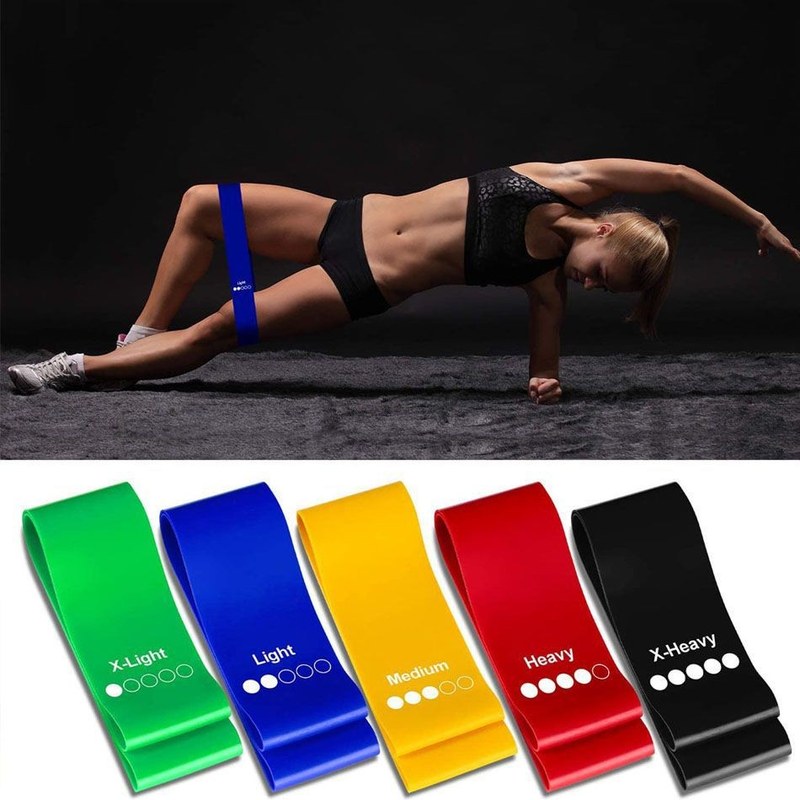
Scoring Suppliers: A Sample Comparison Sheet
Put every supplier's numbers into one sheet and score them the same way. This is a simplified version of the scorecard buyers have shared with us; the weights reflect what drives returns in this category, not what looks best in a photo.
| Criterion | Weight | What earns full marks |
|---|---|---|
| Force consistency within a level | 25% | All pieces within 10%; tag values reproducible with your method |
| Fatigue and permanent set | 20% | ≤5% force drop and ≤3% set after 500 cycles |
| Dimensional accuracy | 15% | Thickness ±0.05 mm, no measurable taper |
| Edge quality under stretch | 15% | Clean edges at 300% on the destructive sample |
| Documentation | 10% | Measured tags, test method, material declaration, compliance reports |
| Colour, print and finish | 10% | Matches reference, print survives rub test, no tack |
| Responsiveness | 5% | Brief answered in full within 24 hours, samples shipped when promised |
Notice that colour and finish — the things you judge in the first ten seconds after opening the pouch — carry only 10%. The top three criteria are all measurements. A supplier who wins on looks and loses on force consistency will cost you more in returns than the unit price saved.
Red Flags in the Sample Stage
- One sample per level, "to save you shipping". One band tells you nothing about consistency. Three bands weigh about 60 g more.
- No numbers on the tag, or force stated only as "light / medium / heavy". The factory either does not measure or does not want to be held to it.
- Samples ship from a different city than the factory address. Common with trading companies. Not automatically a problem, but it means the sample was picked from someone else's stock, and your order will be too.
- Samples are noticeably better than the supplier's retail listings or buyer reviews of the same product. Hand-selected samples from virgin compound are a known pattern; the bulk order runs on a cheaper blend.
- Refusal to credit custom sample fees against a first order of normal size. The fee itself is small; the refusal tells you how disputes will be handled.
- Pushback on signing a PPS. If a supplier will not sign a production sample with measured values, they are reserving the right to ship something different.
- A strong rubber or ammonia smell on a band sold as TPE. TPE has little odour. A strong smell suggests natural latex or reclaimed rubber — a problem if you are selling into clinics or schools as latex-free. See our TPE vs latex comparison for how the two materials behave differently over time.
From Development Sample to Signed Golden Sample
Once you have chosen a supplier and approved the design, the sign-off sequence is short but should not be compressed:
- Written feedback on the development sample with numbers: "Level 3 force 6.4 kg, target 5.5 ±0.5 kg; colour slightly warm vs Pantone 3435 C." Vague feedback ("a bit heavy") produces a second vague sample.
- One revision round (7-10 days) if needed. Most first custom samples need one adjustment to colour or force. Two rounds is normal for a new compound; three suggests a capability gap.
- Deposit and PO, with the spec sheet attached — dimensions, tolerances, force at a stated elongation, colour reference, packaging, inspection standard. Our QC inspection checklist includes the full spec sheet template.
- PPS pulled from the first hours of production — three identical sets, measured, tagged, signed by both parties. One stays at the factory, one goes to you, one to your inspection agency.
- Mass production starts only after PPS approval. A factory that runs your full order before you approve the PPS has turned the PPS into a formality.
For printed or co-branded products, approve the packaging proof in the same step. Printed sleeves and colour boxes often have a longer lead time than the bands; see the packaging guide for typical options and MOQs.
The Real Timeline: Sample Request to Container Arrival
Here is what a custom first order actually looks like, week by week, for 1,000-5,000 sets shipped by sea from Shanghai or Ningbo.
| Stage | Duration | Cumulative |
|---|---|---|
| Brief sent, quotes and stock samples dispatched | 5-7 days | Week 1 |
| Courier to you (DHL / FedEx) | 3-5 days | Week 2 |
| Testing and supplier selection | 3-7 days | Week 3 |
| Custom colour / logo sample + courier | 10-15 days | Week 5 |
| One revision round (if needed) | 7-10 days | Week 6-7 |
| PO + deposit, PPS approval, mass production | 15-20 days | Week 9-10 |
| Pre-shipment inspection, booking, loading | 4-9 days | Week 10-11 |
| Sea freight, port to port | 14-20 days to US West Coast; 30-35 to US East Coast / N. Europe | Week 13-16 |
Two things shorten this. First, approving an existing stock colour removes the custom sample and revision rows — roughly three weeks. Stock-colour production can start within days of the PO. Second, sampling suppliers in parallel rather than one after another. The things that lengthen it are nearly always on the buyer's side: artwork arriving late, feedback given as impressions instead of numbers, and a PO issued before the packaging proof is final. For duty, freight and landed cost on the same shipment, see our guide to importing resistance bands from China.
Reorders: Planning So You Never Sample Twice
A properly signed PPS pays off on every repeat order. Your reorder should reference the PPS number and spec sheet revision, and it should not need new samples unless something changes. What does need planning is timing.
Reorder point = daily sales × total lead time + safety stock. A worked example for an Amazon seller moving 50 sets a day:
| Component | Days | Note |
|---|---|---|
| Repeat production (no new samples) | 20 | 15-20 days for 1,000-5,000 sets; allow the upper end |
| Inspection, booking, loading | 7 | Vessel schedules slip; budget for it |
| Sea freight + customs + trucking | 35 | US West Coast example |
| Warehouse / FBA check-in | 14 | Longer in Q4 |
| Safety stock | 21 | Three weeks of cover |
| Total | 97 | Reorder at 97 × 50 ≈ 4,850 sets on hand |
Resistance bands have two calendar effects that break a flat reorder point:
- The January peak. New Year fitness demand typically lifts band sales sharply in late December and January. Stock for it must land by early December, which means the PO goes out in early October.
- Chinese New Year. In 2027 it falls on 6 February. Output slows in the last two weeks of January, stops for about two weeks, and takes one to two more weeks to recover — effectively a 4-5 week gap, right after your peak. Place the post-holiday reorder before mid-December so it is produced before the shutdown.
If you sell across several channels, our Amazon FBA sellers guide covers packaging and labelling for inbound shipments, and the wholesale ordering guide covers price breaks by volume.
What a Sample Costs Compared With What It Protects
A full sampling round across three suppliers — stock samples, one custom round with your preferred supplier, courier both ways and a $40 test kit — typically costs $250-400 and three weeks. A first order of 3,000 five-band sets is a five-figure commitment before freight. The sample stage costs around 2-3% of that and is the only point at which switching supplier is free.
Buyers who skip it usually do so to save the three weeks. The irony is that the most common consequence of a skipped or rushed sample stage is a bulk order that fails inspection or generates returns — and that costs far more than three weeks.
Frequently Asked Questions
Are resistance band samples free?
Stock samples usually are — you pay the courier, typically $25-40 by DHL or FedEx. Custom samples in your colour, with your logo or at a non-standard thickness cost $50-100 because they need a compounding and extrusion trial; that fee should be credited against your first order.
How many samples should I order?
Three per resistance level plus one extra per level for destructive testing. For a five-level set that is about 20 bands — still one courier pouch. One band per level shows you the supplier's best band; three show you their consistency.
How long do samples take from China?
Stock samples: 5-7 days to dispatch plus 3-5 days courier, so 8-12 days door to door. Custom colour or logo samples: 7-10 working days plus courier, roughly two to three weeks. Allow one 7-10 day revision round on a first custom order.
How do I test samples without a lab?
Use a digital luggage scale and calipers. Stretch each band to 100% elongation and read the force after a three-second hold; measure thickness at three points. Samples of the same level should agree within about 10% on force and 0.05 mm on thickness. Then run 500 stretches on a spare band and re-measure — force should drop no more than about 5%.
What is a pre-production (golden) sample?
A sample pulled from the actual production line — real compound, real die, real printing setup — measured, tagged and signed by both parties. It is the reference for inspection. A development sample proves the design; only the PPS proves the process.
How long from sample approval to shipment?
For 1,000-5,000 sets, 15-20 days of production after PPS approval, plus 4-9 days for inspection, booking and loading. Sea freight adds 14-20 days to the US West Coast or 30-35 days to the East Coast and Northern Europe.
When should I order around Chinese New Year?
Chinese New Year 2027 is on 6 February, and factories lose roughly four to five weeks of output around it. Order January-peak stock by early October, and confirm post-holiday orders with an approved PPS by mid-December.
Related Guides
- Resistance Band Quality Control: AQL Inspection Checklist — what happens to your signed sample at pre-shipment inspection
- How to Measure Resistance Band Weight — the force test in full detail
- Custom Resistance Bands: OEM Guide — colour matching, logo methods and custom tooling
- Private Label Resistance Bands Guide — building a brand around a factory product
- Importing Resistance Bands from China: HTS Codes & Landed Cost — the steps after your goods leave the factory
- Compliance: CPSIA, Prop 65, REACH & GPSR — the documents to request with your samples
Request Measured Samples from a TPE Factory
TAICLET compounds its own TPE and extrudes every band in-house in Danyang, Jiangsu. Free stock samples (you pay courier only) ship in 5-7 days with thickness and force written on every tag. Custom colour and logo samples in 7-10 working days, fee credited on your first order. OEM MOQ 200 sets, wholesale 1,000 sets, reply within 12 hours.