
Why Do Resistance Bands Snap? Lifespan, Causes & Replacement Guide
Published 2026-09-07 · 11 min read · Technical Guide
Quick answer: resistance bands almost never fail from "wearing out." They fail from four specific mechanisms — a nick that propagates into a tear, ozone and UV attack on the polymer, stretching past the rated elongation, and abrasion at the anchor point. Fix those four and a band reaches its full service life: roughly 1-2 years for quality latex, 2-3 years for TPE, in daily use.
We manufacture and destructively test resistance bands for a living. Every batch that leaves our factory has been fatigue-cycled and pulled to break, so we see failure surfaces most people never look at. This guide explains what those failures actually look like, how long bands genuinely last by material, and how gyms, clinics and schools should schedule replacement.
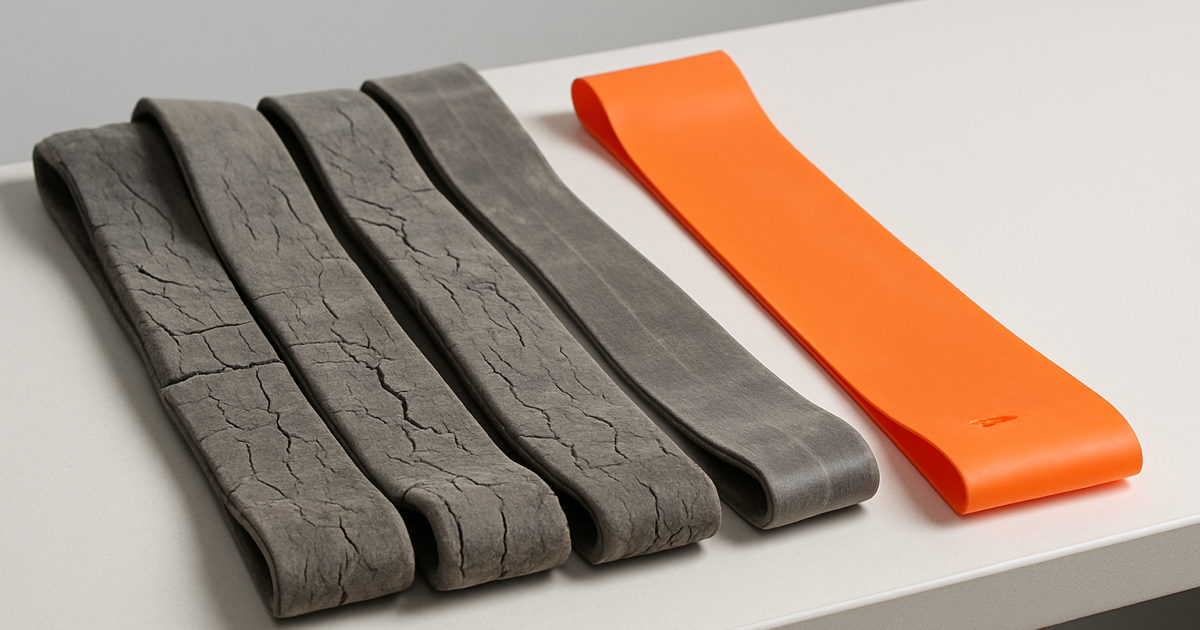
The Four Reasons Resistance Bands Snap
1. Notch propagation — the single biggest cause
Elastomers are extremely tough in pure tension and extremely weak once a defect exists. A nick 0.5 mm deep in a 0.6 mm therapy band removes most of its effective cross-section at that point, and under load the tear runs across the band in milliseconds.
Where the nicks come from, in order of frequency in our field returns:
- Fingernails and rings gripping the band directly
- Rough anchor points — unfinished rack uprights, door hinges, screw threads, cinder block
- Shoe treads and outsole edges when the band is stepped on
- Concrete and asphalt from dragging the band on the ground
- Scissors marks where a roll band was cut to length without a clean, straight cut
When we examine a broken band, a notch failure is obvious: the break has one clean initiation point on an edge and a fan-shaped tear surface running away from it. A genuine end-of-life failure looks completely different — see below.
2. Ozone and UV attack
This is where material chemistry decides lifespan. Natural rubber latex is polyisoprene, and its polymer backbone contains carbon-carbon double bonds. Atmospheric ozone attacks those double bonds directly, splitting the chain and producing the fine surface crazing that anyone who has found an old band in a garage will recognise. UV accelerates the same oxidation.
TPE grades such as SEBS have a saturated backbone — no double bonds for ozone to attack — which is the core reason TPE bands age far better on the shelf and in bright gyms. We cover the full material comparison in TPE vs latex resistance bands, but the short version is that latex wins on peak tensile strength when new and loses badly on aging.
Ozone sources people do not think about: electric motors, photocopiers, air purifiers marketed as "ozone generators", and welding equipment. A band stored in a room with any of those degrades faster than one in a drawer.
3. Over-elongation
Every band has a rated working elongation and a much higher break elongation. Our TPE tube stock, tested to ASTM D412, breaks at 750% or more elongation — but the rated working range is far lower, typically up to 200-250%.
Repeatedly working near the break point causes permanent set: the chains slide past one another and the band no longer returns to its resting length. Once permanent set exceeds about 10%, the band's actual force no longer matches its label, and the safety margin to break has shrunk. If you are unsure what your band is really producing, our guide on how to measure resistance band weight shows how to check it with a $20 scale.
Practical rule: if you are stretching a band more than 2.5x its resting length to get enough resistance, you have the wrong band. Move up a level or use a shorter one.
4. Anchor abrasion
Anchor points concentrate both friction and stress. A band looped directly over a door frame edge sees the entire load across a few millimetres of contact, and every rep saws it slightly. This is why door anchors exist — a proper door anchor spreads the load across a padded strap instead of a hard edge. The same logic applies to rack uprights: wrap a towel or use a purpose-made sleeve.
How Long Do Resistance Bands Actually Last?
Lifespan depends far more on material and storage than on brand. These are the ranges we quote to our wholesale customers, based on our own fatigue testing and field replacement data:
| Material | Daily use | 2-3x/week | Unused shelf life | Ozone / UV resistance |
|---|---|---|---|---|
| Budget latex | 6-12 months | 1-1.5 years | 1-2 years | Poor |
| Quality natural latex | 1-2 years | 2-3 years | 2-3 years | Fair |
| TPE (SEBS) | 2-3 years | 3-4 years | 3-5 years | Excellent |
| Fabric-covered (elastic core) | 3-5 years | 5+ years | 5+ years | Excellent (core shielded) |
Fabric bands last longest for a simple reason: the fabric sleeve blocks UV, absorbs abrasion, and keeps skin oils and sweat off the elastic core. That is also why they cost 3-5x more per unit. See fabric vs TPE vs latex for the full cost-durability tradeoff.
Running a gym, clinic or school and tired of replacing bands? Our TPE bands are fatigue-tested to 10,000+ cycles. Ask for a durability sample pack — MOQ from 1,000 pieces.
What We Test For, and What "10,000+ Cycles" Means
Fatigue testing is the only honest way to compare durability claims. Our standard protocol:
- Cycle count: 10,000+ cycles at 100% elongation with less than 10% force loss
- Tensile strength: ≥ 3,500 psi per ASTM D412
- Elongation at break: ≥ 750%
- Permanent set after cycling: ≤ 5%
- Heat aging: 70°C for 168 hours, tensile retention ≥ 80%
To put 10,000+ cycles in perspective: a physical therapy patient doing 3 sets of 15 reps, 5 days a week, accumulates about 11,700 cycles a year. A band that holds its rating for 10,000+ cycles therefore has roughly 2.5 years of clinical duty in it — which matches the field data in the table above. If a supplier quotes a cycle number without stating the elongation and the allowed force loss, the number means nothing.
Failure Modes: How to Read a Broken Band
| What you see | Cause | Preventable? |
|---|---|---|
| Clean tear from one edge, fan-shaped surface | Notch propagation from a nick | Yes — inspect edges, protect anchors |
| Fine surface cracks, chalky or dull look | Ozone / UV degradation | Yes — dark, cool storage; switch to TPE |
| Band no longer returns to original length | Permanent set from over-elongation | Yes — use a heavier band, not more stretch |
| Thinned, fuzzy or shiny patch mid-band | Anchor or floor abrasion | Yes — use a door anchor or sleeve |
| Sticky, tacky surface | Latex breakdown from oil, sweat or heat | Partly — retire the band |
| Break at a moulded seam or handle joint | Manufacturing defect or weak crimp | No — supplier quality issue |
That last row is worth dwelling on if you are sourcing. Handle and clip attachment points are where cheap tube band sets fail first — not in the tube itself. Ask any supplier for pull-test data on the assembled product, not just the raw tube.
Is a Snapping Band Dangerous?
Yes, and the risk is concentrated in the eyes. A band under high tension that releases at an anchor point can cause corneal abrasion, hyphaema and retinal injury; such cases are documented in the ophthalmology case literature, most commonly when the anchor gives way during a face-on pulling movement.
Four rules that eliminate most of the risk:
- Never position your face in the line of the band during a horizontal pull from a fixed anchor.
- Inspect before every session — 5 seconds running the band through your fingers finds nicks you cannot see.
- Never exceed 2.5x resting length. If you need more resistance, use a heavier band.
- Retire on the first sign of degradation, not on the first break. A band costs a few dollars; an eye injury does not.
For clinical and school settings, this is also an argument for TPE over latex beyond the allergy question: TPE fails progressively and visibly rather than suddenly. Schools buying chair bands should build inspection into the termly routine — our classroom fidget band guide covers that in detail.
The 60-Second Inspection Checklist
- Run it through your fingers, full length, both edges. Feel for nicks, notches and rough spots.
- Hold it to a light and stretch to 50%. Thin spots and internal flaws show as brighter areas.
- Look for crazing — a network of fine surface cracks means ozone damage. Retire immediately.
- Check colour and finish. Chalky, faded or sticky means degraded. Retire.
- Measure resting length against the original spec. More than 10% longer means permanent set. Retire.
- Check attachment points on tube sets — carabiners, crimps, handle seams.
Any single failed item means retire, not "watch it." Elastomer failure is not gradual once a defect exists.
Replacement Schedules for Commercial Buyers
Consumers can replace on inspection. Shared-use environments should not — nobody owns the inspection, so it does not happen. Use fixed intervals:
| Setting | Users per band | Replace every | Notes |
|---|---|---|---|
| Commercial gym floor | High, uncontrolled | 6-9 months | Highest abrasion and misuse rate |
| Physical therapy clinic | Moderate, supervised | 9-12 months | Or single-patient issue, then discard |
| School classroom bands | 1 per chair, daily | 12-18 months | Inspect each term; low tension helps |
| Corporate wellness kits | 1 per employee | 18-24 months | Low frequency, good storage |
| Home / retail sets | 1-2 | 18-24 months | Print care instructions on packaging |
Clinics in particular should note the single-patient option: at TPE wholesale pricing, issuing a band to a patient and never taking it back is often cheaper than the cleaning and inspection labour of reusing it — and it removes cross-contamination entirely. Pricing for that model is covered in our physical therapy wholesale guide.
Storage: The Cheapest Way to Double Lifespan
- Temperature: 10-25°C. Never a hot car — cabin temperatures above 60°C accelerate oxidation dramatically.
- Light: dark storage. An opaque bag or closed drawer, not a sunny windowsill or clear display bin.
- Tension: store loose and flat or loosely rolled. Never knotted, never stretched over a hook long-term.
- Moisture: dry the band after sweaty sessions. Damp bags accelerate surface breakdown on latex.
- Chemicals: keep away from oils, lotions, solvents and chlorine. Body lotion transferred from skin is a common and invisible cause of latex tackiness.
- Ozone: away from electric motors, air purifiers and photocopiers.
Cleaning: mild soap and water, air dry out of sunlight. Do not use alcohol wipes or disinfectant sprays on latex repeatedly — they strip the surface. TPE tolerates cleaning far better, which is another reason clinics and schools have moved to it.
Frequently Asked Questions
Why do resistance bands snap?
Four causes cover nearly every failure: notch propagation from a nick, ozone and UV attack on the polymer, over-elongation past the rated stretch, and abrasion at the anchor point. Age alone rarely snaps a band — age plus one of these four does.
How long do resistance bands last?
In daily use: 6-12 months for budget latex, 1-2 years for quality latex, 2-3 years for TPE, and 3-5 years for fabric-covered bands. Unused shelf life is about 2-3 years for latex and 3-5 years for TPE stored cool, dark and dry.
Do TPE bands last longer than latex?
For aging and environmental durability, clearly yes. Latex is polyisoprene with double bonds in the backbone that ozone and UV attack directly. TPE grades like SEBS have a saturated backbone with no such bonds. Latex retains roughly 15-20% higher tensile strength when new, so the tradeoff is peak strength versus aging resistance.
Can a snapping band injure you?
Yes — eye injuries are the main documented risk, including corneal abrasion, hyphaema and retinal damage when an anchor releases during a face-on pull. Never put your face in the band's line, inspect before every session, stay within 2.5x resting length, and retire bands at the first sign of degradation.
How should I store resistance bands?
Cool (10-25°C), dark, dry and loose. Not in a hot car, not on a windowsill, not knotted or stored under tension, not damp in a gym bag, and away from ozone sources like electric motors and air purifiers. Good storage alone can double usable life.
How often should a gym or clinic replace bands?
Use fixed intervals rather than waiting for damage: commercial gym 6-9 months, PT clinic 9-12 months, classroom chair bands 12-18 months, corporate and home kits 18-24 months. Pair with a monthly visual and stretch check.
What does it mean if my band is sticky or has stopped springing back?
Sticky means surface degradation from oil, sweat, heat or ozone — retire it. Loss of spring-back is permanent set from repeated over-stretching; once resting length is more than 10% longer than original, the force rating no longer matches the label and the band should be replaced.
Related Guides
- How to Measure Resistance Band Weight (lbs & kg)
- TPE vs Latex Resistance Bands: Factory Test Data
- Fabric vs TPE vs Latex: Which Should You Sell?
- How Resistance Bands Are Made: Factory Process
- Wholesale Resistance Bands: Bulk Ordering & Pricing
Bands That Survive Commercial Use
TAICLET manufactures latex-free TPE bands fatigue-tested to 10,000+ cycles, with ASTM D412 test reports supplied per batch. Custom resistance, colour, width and branding. MOQ from 1,000 pieces.