
How to Measure Resistance Band Weight (lbs & kg): The Factory Test Method
Published 2026-09-07 · 12 min read · Technical Guide
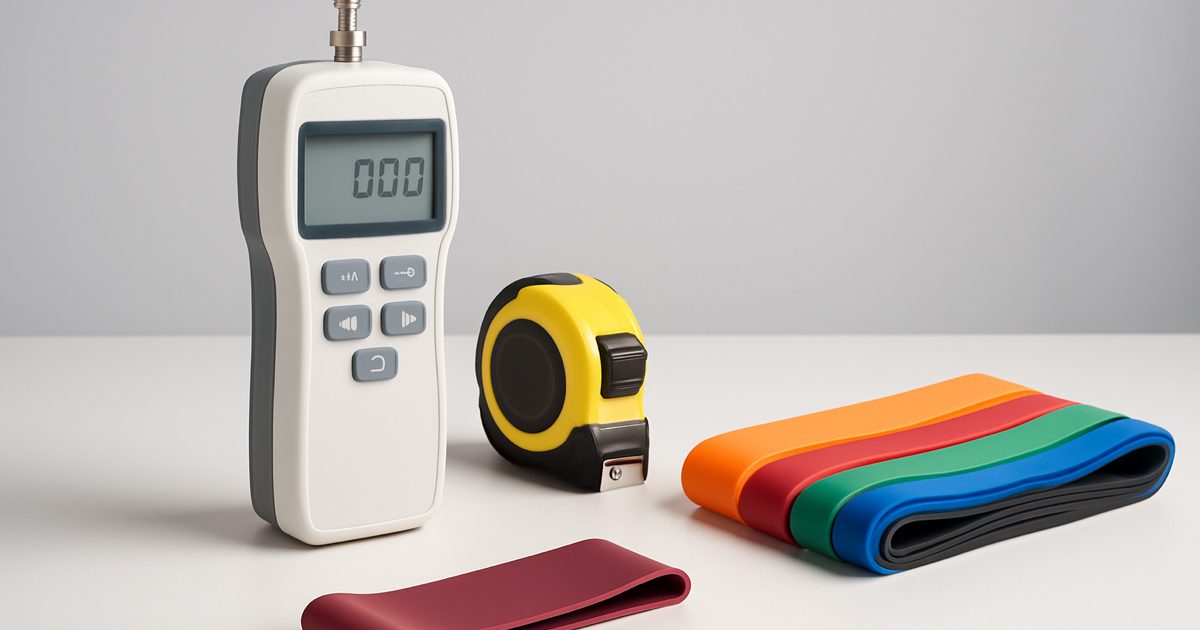
Quick answer: anchor one end of the band, hook a digital luggage scale or force gauge to the other, pull until the band reaches a defined stretched length, and read the force. The number only means something if you also record the elongation — the same band reads roughly twice as high at 100% stretch as it does at 25% stretch. Everything else in this guide is about getting that one variable right.
We run this test hundreds of times a week. TAICLET is a TPE resistance band manufacturer, and every production batch is force-tested before it ships. This guide is the same procedure our QC team uses, written so a trainer with a $18 luggage scale can get within a few percent of a calibrated lab result.
Why Resistance Band "Weight" Is Not Like Dumbbell Weight
A 20 lb dumbbell is 20 lb at the bottom of the rep and 20 lb at the top. A band is not. Band force follows the elastic modulus of the compound: as you stretch it, force climbs, steeply at first and then more gradually as the polymer chains align.
This is why a band labelled "50 lbs" may deliver 12-18 lb in the first third of the movement and only touch 50 lb at maximum rated extension. Neither number is a lie — they are just measured at different points on the same curve.
Three consequences that matter in practice:
- A single number is always incomplete. Force must be paired with an elongation percentage to be reproducible.
- Longer bands feel lighter. A 41-inch pull-up band stretched 20 inches is at ~49% elongation; a 12-inch mini loop stretched the same 20 inches is at 167% elongation and will feel dramatically harder.
- Ranges are honest, single numbers are marketing. "15-35 lbs" tells you the working curve. "35 lbs" tells you the peak and hides the rest.
The Elongation Rule: The One Thing Everyone Gets Wrong
Elongation is expressed as a percentage of the band's resting length:
- 50% elongation = stretched to 1.5x resting length (a 20" band pulled to 30")
- 100% elongation = stretched to 2x resting length (a 20" band pulled to 40")
- 200% elongation = stretched to 3x resting length (a 20" band pulled to 60")
Industry ratings are most commonly quoted at 100% elongation, and clinical literature usually reports the full curve. Independent laboratory measurements published in the Journal of Physical Therapy Science (2016) put numbers on exactly how much the reading moves with stretch:
| Thera-Band colour | 25% stretch | 100% stretch | 200% stretch | Increase, 25% → 200% |
|---|---|---|---|---|
| Tan | 0.97 lb | 2.38 lb | 3.48 lb | 3.6x |
| Yellow | 1.06 lb | 2.58 lb | 3.73 lb | 3.5x |
| Red | 1.43 lb | 3.53 lb | 4.98 lb | 3.5x |
| Green | 1.72 lb | 4.01 lb | 6.42 lb | 3.7x |
| Blue | 2.54 lb | 5.53 lb | 7.76 lb | 3.1x |
| Black | 2.80 lb | 7.23 lb | 11.53 lb | 4.1x |
| Silver | 3.40 lb | 8.58 lb | 13.03 lb | 3.8x |
| Gold | 5.69 lb | 12.48 lb | 16.65 lb | 2.9x |
Converted from kilogram-force values reported by Uchida et al., J Phys Ther Sci 28(4), 2016, measured on 0.3 m band samples with an electronic tensiometer. Thera-Band's own published figures at 100% elongation (Tan 2.4 lb, Yellow 3.0 lb, Red 3.7 lb, Green 4.6 lb, Blue 5.8 lb, Black 7.3 lb, Silver 10.2 lb, Gold 14.2 lb) sit slightly higher, which is normal — sample width, grip type, and pull speed all shift the result by a few percent.
Read the last column again: the same band produces 3-4x more force at 200% stretch than at 25%. That single fact explains almost every "my band is mislabelled" complaint we receive.
Sourcing bands and need verified numbers? We supply force-test reports with every batch. Request our test protocol and sample pack.
Method 1: The Digital Luggage Scale (Best for Gyms and Clinics)
Accuracy: roughly ±0.5 lb. Cost: $15-25. This is what we recommend to trainers, physical therapists, and buyers doing incoming inspection without a lab.
- Measure resting length. Lay the band flat, unstretched, on a tape measure. For a loop band, measure the loop flat and note it — you will work in flat length throughout. Record this as L₀.
- Calculate your target length. For a 100% elongation rating, target = 2 × L₀. For a 50% rating, target = 1.5 × L₀.
- Anchor one end. A door anchor, squat rack upright, or a loop over a fixed hook. Do not hold it by hand — hand slip is the largest source of error.
- Hook the scale to the free end and pull along the band's axis, in line, not at an angle.
- Pull slowly to the target length — about 3 seconds. Fast pulls read high because of the compound's viscoelastic response.
- Hold 2 seconds and read. Use the scale's peak-hold function if it has one, but note that peak-hold will capture the overshoot; a steady read is more representative.
- Repeat 3 times and average. The first pull on a fresh band always reads highest (the Mullins effect — first-stretch softening in filled elastomers). Discard pull one and average pulls two and three.
The mistake to avoid: pulling "as far as it goes" and recording that number. That is a peak reading at an unknown elongation, and it is not comparable to anything.
Method 2: The Bathroom Scale Trick (No Equipment)
Accuracy: roughly ±3-5 lb. Free, and good enough to sort a bin of unlabelled bands into light/medium/heavy.
- Step onto a bathroom scale and record your bodyweight.
- Loop the band under both feet, still standing on the scale.
- Pull the band upward to the position you would actually use in the exercise.
- Read the scale. It will show less than your bodyweight.
- Band force = bodyweight − loaded reading.
This measures force at your real working length, which is arguably more useful for programming than a 100%-elongation lab number. The downside is that bathroom scales are calibrated for static, evenly-distributed load, so expect a few pounds of drift.
Method 3: Calibrated Force Gauge (What We Use in QC)
Accuracy: ±1% of reading. This is the reference method behind every spec sheet we issue.
Our lab uses a bench-mounted digital force gauge on a motorised test stand, pulling at a controlled crosshead speed with pneumatic grips. The relevant standard is ASTM D412, the tension test method for vulcanised rubber and thermoplastic elastomers — the same standard that governs tensile strength and elongation at break.
Typical specification points we test to on a TPE tube band:
- Tensile strength: ≥ 3,500 psi (ASTM D412)
- Elongation at break: ≥ 750%
- Modulus at 100% elongation: ≤ 120 psi
- Force at rated elongation: nominal ±8%, 5 pieces per colour per batch
- Fatigue: 10,000+ cycles at 100% elongation with <10% force loss
You do not need this setup to buy well. You need to know it exists, and to ask whether your supplier has one. More on how to write that into a PO below.
How Rated Force Differs by Band Type
The same measurement procedure produces very different numbers depending on band geometry. This table shows the working ranges we manufacture to, measured at 100% elongation:
| Band type | Typical resting length | Force range | Rated at |
|---|---|---|---|
| Fabric / TPE mini loops | 10-15 in | 5-40 lb | 50-100% elongation |
| Flat therapy bands | Cut to length | 2-15 lb | 100% elongation |
| Long loop / pull-up bands | 41 in | 15-260 lb | Peak at max stretch |
| Tube bands with handles | 48 in | 10-50 lb | 100% elongation |
| Chair / fidget bands | 10-16 in | 3-12 lb | 30-50% elongation |
Note the pull-up band row. Those 15-260 lb figures are peak values, which is why a "50-125 lb" green pull-up band feels nothing like 50 lb when you first step into it. If you want to know what it actually gives you at the bottom of an assisted pull-up, measure it at the elongation you achieve there — usually 40-70%.
Why Two Bands of the Same Colour Measure Differently
Colour is a brand convention, not a standard. There is no ISO or ASTM colour code for resistance bands, which is why our resistance band colour code chart has to be brand-by-brand. Beyond branding, four physical variables move the reading:
- Thickness tolerance. Extrusion or dipping thickness varies. A 0.05 mm thickness change on a 0.5 mm therapy band is a ~10% force change.
- Width. Force scales close to linearly with width. A 4-inch strip is roughly twice the force of a 2-inch strip of the same compound and thickness.
- Compound batch. Filler loading and polymer grade shift the modulus. This is why we test per batch, not per year.
- Temperature. Elastomers stiffen when cold. A band measured at 5°C reads noticeably higher than the same band at 25°C. We condition samples at 23 ± 2°C before testing.
Age matters too: a band that has lost elasticity will read low, which is one of the earliest signs it should be retired — see our guide on how resistance bands are made for what happens to the polymer over its life.
Converting Band Force to Dumbbell Equivalent
The honest answer is that there is no clean conversion, because a band's force curve and a dumbbell's flat load are different stimuli. The practical approach:
- Identify the sticking point of the exercise — the hardest position in the range.
- Measure the band's elongation at that position.
- Measure band force at that elongation using Method 1 or 2.
- That number is your working dumbbell equivalent for that lift.
Example from our own bench: a 12-inch TPE mini loop rated 20-30 lb, used for a banded hip thrust, sits at roughly 80% elongation at lockout and produces 24 lb there — but only 9 lb at the bottom. Programming it as "a 24 lb load" overstates the bottom half of the rep by nearly 3x. For a fuller comparison of the two training modalities, see resistance bands vs weights.
For Buyers: How to Specify Resistance in a Purchase Order
Most resistance complaints we see from brands come down to an incomplete spec. A complete one has four lines:
| Spec line | Weak version | Complete version |
|---|---|---|
| Nominal force | "Medium" | 25 lb (11.3 kg) |
| Elongation | not stated | measured at 100% elongation |
| Tolerance | not stated | ±10% |
| Verification | "supplier QC" | 5 pcs/colour/batch, calibrated gauge, report with shipment |
Written that way, a dispute becomes a measurement, not an argument. Our standard tolerance is ±8% at the rated elongation; commodity suppliers frequently run ±15-20%, which is enough for a customer to feel the difference between two bands from the same pack. Buyers new to sourcing should also read our wholesale resistance bands guide and the custom OEM guide before issuing a first PO.
Quick Reference: Metric Conversions
- 1 kgf = 2.205 lbf (kilogram-force to pounds-force)
- 1 kgf = 9.81 N (to newtons)
- 1 lbf = 4.448 N
- Elongation % = ((stretched length − resting length) ÷ resting length) × 100
If your supplier quotes in kg and your market labels in lb, do the conversion once and print both on the packaging. Retail buyers in the US read lb; clinical and EU buyers read kg or newtons.
Frequently Asked Questions
How do I measure the weight of a resistance band?
Anchor one end, hook a digital luggage scale or force gauge to the other, and pull until the band reaches a defined stretched length — then read the force at that exact length. The step most people skip is defining elongation: the same band reads roughly 3-4x higher at 200% stretch than at 25% stretch, so a rating without a stated stretch percentage is meaningless.
What does it mean when a band says 50 lbs?
Almost always the peak force at the manufacturer's maximum rated stretch, not the force through a normal range of motion. That band may give 12-18 lb at the start of a rep. This is why honest spec sheets publish a range such as 15-35 lb rather than a single number.
How much force does each Thera-Band colour produce?
At 100% elongation, published values are roughly Tan 2.4 lb, Yellow 3.0 lb, Red 3.7 lb, Green 4.6 lb, Blue 5.8 lb, Black 7.3 lb, Silver 10.2 lb, Gold 14.2 lb for a standard-width strip. Independent measurements in the Journal of Physical Therapy Science (2016) confirm the same progression, each clinical-range step adding about 25% over the one below.
Can I use a bathroom scale?
Yes. Stand on the scale, anchor the band under your feet, pull to your working position, and subtract the loaded reading from your bodyweight. Accuracy is about ±3-5 lb because bathroom scales are built for static load. A $15-25 digital luggage scale is considerably more accurate.
Why do two bands of the same colour feel different?
Colour is a brand convention, not a standard. Thera-Band Green is about 4.6 lb at 100% stretch; a generic green pull-up band can be 50-125 lb. Within a brand, thickness tolerance, width, compound batch, and temperature all move the reading. We hold ±8% per batch under ASTM D412; commodity suppliers often run ±15-20%.
How do I convert band force to dumbbell weight?
Match band force at the sticking point of the exercise, not at full stretch. Measure elongation at that position, measure force there, and treat that as the dumbbell equivalent for that lift. A band is easier than a dumbbell at the bottom of the rep and harder at the top.
What tolerance should I require from a supplier?
Specify nominal force, the elongation it is measured at, and the tolerance — for example "25 lb at 100% elongation, ±10%". Require 5 pieces per colour per batch on a calibrated gauge, with the test report attached to the pre-shipment inspection. A supplier who cannot produce one is not measuring.
Related Guides
- Resistance Band Weight Chart kg & lbs: Size Guide by Color Code
- Resistance Band Colour Code Chart: Levels in lbs & kg by Brand
- Resistance Band Size Guide: Length, Width & Thickness
- TPE vs Latex Resistance Bands: Factory Test Data
- How Resistance Bands Are Made: Factory Process
- Wholesale Resistance Bands: Bulk Ordering & Pricing
Need Bands That Actually Match Their Label?
TAICLET force-tests every production batch on calibrated gauges and ships the report with your goods. Custom resistance calibration, colour, width, and branding available. MOQ from 1,000 pieces.