
Importing Resistance Bands from China: HTS Codes, the Duty Stack & Real Landed Cost
Updated 2026-09-10 · 14 min read · Sourcing & Logistics
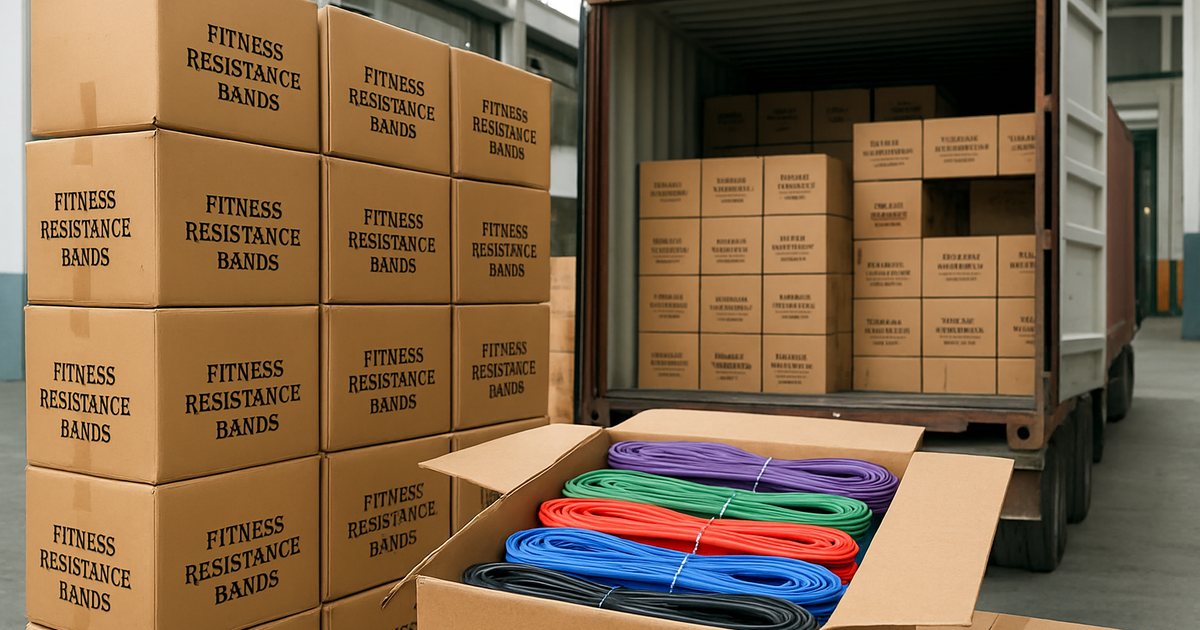
Quick answer: resistance bands enter the US under HTS 9506.91.0030 at a 4.6% MFN duty, plus Chapter 99 additional duties for China origin that you must verify on the week you ship. Add MPF 0.3464% and HMF 0.125%, ocean freight, and destination charges. Our standard export carton is 50 × 40 × 30 cm / 0.060 CBM, and a 20GP holds about 466 cartons — roughly 69,900 five-band mini loop sets. Retail boxes triple that volume.
We are a TPE resistance band factory in Ningbo and we load these containers every week. Most importing guides you will find for this product are written by freight forwarders who have never packed a band. This one has the carton dimensions, the pieces per container, and the four places where importers in this specific category lose money.
Step 1: Get the Classification Right Before You Get a Quote
Every other number in your landed-cost model hangs off the tariff line, so this is not a detail to leave to the last week.
Resistance bands are normally classified under HTS 9506.91.0030 — "Articles and equipment for general physical exercise, gymnastics or athletics; parts and accessories thereof: Other" — carrying an MFN duty of 4.6% ad valorem. CBP has applied this subheading to fitness bands and exercise straps in published rulings available through the CROSS ruling database, so this is settled ground rather than an opinion.
Where it gets interesting is the edge of the catalogue:
| Product | Usual classification | Why it can move |
|---|---|---|
| TPE / latex mini loop bands | 9506.91.0030 | Clear exercise function, no ambiguity |
| Flat therapy bands, rolls | 9506.91.0030 | Bulk roll sold to clinics still reads as exercise equipment |
| Pull-up assist bands | 9506.91.0030 | Same heading; no separate line for looped bands |
| Fabric-covered hip / booty bands | 9506.91.0030 in most entries | Made-up textile articles can fall to 6307.90 if the exercise function is not evident from the article itself |
| Band + handle + door anchor kit in one box | Usually a set, classified by essential character | Sets take the classification of the component giving essential character — usually the bands |
| Printed sleeves, mesh bags shipped separately | Own headings | Packaging shipped loose is not packing material and classifies on its own |
The practical rule: one classification decision per SKU family, made in writing, before the first PI is signed. If you sell both rubber loops and fabric hip bands, ask your broker to look at both and document the reasoning. If you want certainty on an unusual configuration, a binding ruling request through CBP costs nothing but time and gives you a defensible position for years.
Step 2: Understand the Tariff Stack — Not Just "The Tariff"
The single biggest error we see in buyer spreadsheets is a cell labelled "tariff" holding one number. A China-origin entry in 2026 is layered:
- The MFN rate from Chapter 95 — 4.6% for 9506.91.0030. Stable, published in the HTSUS, changes rarely.
- Chapter 99 additional duties — the Section 301 lines and the additional trade-action lines added since 2025. These attach to your 10-digit code as separate tariff lines on the entry summary, each with its own legal authority and its own effective dates.
- User fees — MPF and HMF, below.
We are deliberately not printing a single "current total rate" in this guide, and you should be suspicious of any supplier blog that does. These rates changed multiple times through 2025 and 2026, and a page written six months ago is worse than no page at all because it reads as authoritative. The correct procedure takes four minutes:
- Enter your full 10-digit code at hts.usitc.gov and read every Chapter 99 cross-reference note attached to it.
- Check the latest CBP CSMS guidance messages for the trade action in question — they carry the effective dates and any in-transit exemptions.
- Have your broker confirm in writing on the week the vessel sails, not the week you quote your customer.
One structural note worth knowing: duty is assessed on the entered value, which for a normal FOB purchase is the price you pay the factory — international freight and insurance are not part of it. That is why the incoterm you choose has a direct duty consequence, covered in Step 6.
Modelling a first order? Send us your target SKU mix and retail format and we will return the exact carton dimensions, CBM, gross weight and pieces-per-container for your configuration — the inputs your broker needs to quote a real landed cost. Request packing data →
Step 3: The Numbers Nobody Publishes — Cartons, CBM and Container Loading
This is the part your freight forwarder cannot tell you and your competitor will not. These are our standard export packing figures as of September 2026, for poly-bagged and mesh-bag configurations without retail boxes.
| Product | Per carton | Carton CBM / GW | Per 20GP | Per 40HQ |
|---|---|---|---|---|
| 5-band mini loop set, mesh bag + sleeve | 150 sets | 0.060 / 21 kg | ~69,900 sets | ~170,000 sets |
| Single mini loop band, bulk polybag | 1,000 pcs | 0.060 / 24 kg | ~466,000 pcs | weight-limited, ~1,050,000 pcs |
| Flat therapy band, 25 m bulk roll | 12 rolls | 0.060 / 22 kg | ~5,590 rolls | ~13,500 rolls |
| Pull-up assist band, 83 mm width | 30 pcs | 0.060 / 22 kg | ~13,900 pcs | ~34,000 pcs |
| Tube set with handles, retail box | 40 sets | 0.077 / 22 kg | ~14,500 sets | ~35,300 sets |
| Chair kick bands, school bulk pack | 500 pcs | 0.060 / 19 kg | ~233,000 pcs | ~566,000 pcs |
Basis: 28 CBM usable in a 20GP, 68 CBM in a 40HQ. Carton specs change with retail packaging — always confirm against your own proforma invoice.
Two things fall out of that table immediately.
Bands are a volume product, not a weight product. Except for bulk-polybagged loose bands, you run out of cubic metres long before you approach the payload limit. That means every millimetre of packaging air you ship is money, and it means gross weight is the wrong variable to optimise. Buyers who negotiate hard on carton weight and ignore carton dimensions are optimising the number that does not bill.
Retail packaging is the single largest controllable freight cost in this category. Here is the same order in two formats:
| 10,000 five-band sets | Volume | Cartons | Share of a 20GP |
|---|---|---|---|
| Mesh bag + folded sleeve | ~4.0 CBM | 67 | 14% |
| Printed window box, flat-packed insert | ~8.5 CBM | 142 | 30% |
| Rigid printed box with tray | ~13.5 CBM | 225 | 48% |
The rigid box costs more to buy and more than triples the freight. On typical FCL economics the freight delta alone runs $0.06-0.12 per set, which is often more than the box. If you are still deciding formats, our packaging configuration guide walks through which formats actually lift sell-through enough to justify the cube.
Step 4: Freight — and the LCL Trap
Ocean rates on the China–US and China–Europe lanes have been volatile enough that quoting a number here would be irresponsible. What does not change is the structure of the decision:
| Shipment size | Mode | Why |
|---|---|---|
| Under 2 CBM | Compare LCL vs air seriously | LCL destination fixed charges can exceed the ocean freight itself |
| 2-13 CBM | LCL | Pay per CBM, no container commitment |
| 13-28 CBM | 20GP FCL | Usually beats LCL on cost per CBM and removes deconsolidation risk |
| Over 30 CBM | 40HQ FCL | Best cost per CBM; bands rarely hit the weight limit |
The LCL trap is not the freight rate — it is the destination handling. LCL cargo is deconsolidated at a CFS warehouse where your cartons are moved by people who have no relationship with you. In our experience the two failure modes are crushed cartons (bands are light, so cartons stack badly under heavier neighbours) and short counts that are impossible to prove after the fact. If you ship LCL, specify double-wall cartons and full-carton counts marked on every side. It costs a few cents and settles arguments.
One more practical point: 15 CBM is roughly 250 cartons or 37,000 five-band sets. Brands often discover their second order should have been an FCL and nobody told them, because the forwarder quotes what you ask for.
Step 5: Building the Actual Landed Cost Model
Here is the full line-item structure, with a worked example on 20,000 five-band mini loop sets at an FOB Ningbo price of $1.35 per set. Duty percentages beyond MFN are left as variables on purpose — fill them from your broker's confirmation.
| Line | Basis | Example (20,000 sets) |
|---|---|---|
| FOB goods value | $1.35 × 20,000 | $27,000 |
| Tooling / logo mold, apportioned | One-off, see assists below | $1,200 first order |
| Ocean freight | ~8 CBM, LCL or part FCL | market rate |
| Marine insurance | 0.15-0.35% of CIF value | ~$60-100 |
| MFN duty | 4.6% of entered value | $1,242 |
| Chapter 99 additional duties | Rate × entered value | verify with broker |
| MPF | 0.3464% of entered value | $93.53 |
| HMF (ocean only) | 0.125% of cargo value | $33.75 |
| Customs bond | Single-entry or annual continuous | annual bond usually cheaper past 3 entries |
| Broker fee | Per entry | $100-250 |
| Drayage + delivery | Port to warehouse | market rate |
| Third-party inspection | Per man-day | $250-350 |
MPF is 0.3464% of entered value for formal entries, with an annually adjusted floor and ceiling — for fiscal year 2026, effective 1 October 2025, the minimum is $33.58 and the maximum $651.50. HMF is 0.125% of cargo value on vessel arrivals with no minimum or maximum, and it has been unchanged since 1987. Together they add about 0.47% — small, but they belong in the model, and the MPF ceiling means large entries get proportionally cheaper.
The assist rule catches almost every OEM buyer eventually. If you pay for a logo mold, an embossing plate or artwork tooling and hand it to the factory free or below cost, US valuation rules treat that as an assist that must be added to the transaction value of the goods it produces. On a $1,200 mold that is pennies per unit — but omitting it entirely is a valuation error, and valuation errors surface in audits with interest attached. Tell your broker at the first entry and apportion it across the production run. Our custom OEM guide covers what tooling actually costs and who should own it.
Step 6: Incoterms — Why We Recommend FOB Ningbo
Three terms come up in this category, and the differences matter more than the price comparison suggests.
| Term | What you control | Where it hurts |
|---|---|---|
| EXW | Everything, including China-side export clearance | You own export declaration risk in a country you do not operate in; rarely worth it |
| FOB Ningbo | Freight, broker, entry, insurance | You need a forwarder — but every cost is visible and the entered value is clean |
| CIF | Broker and entry only | Supplier picks the carrier; destination charges are where the margin hides |
| DDP | Nothing | You are still importer of record in most structures but cannot see how the goods were declared in your name |
DDP is seductive for a first order — one number, no forwarder to hire. The problem is that a DDP price is a bet on tariff rates by a party that is not liable for the entry. When rates move mid-shipment, DDP quotes get reopened or shipments sit. And if the declared value is optimised on your behalf, the consequences arrive at your door, not the supplier's. Take FOB, appoint your own broker, and read your own entry summary. It is one afternoon of setup that you reuse for every order after.
The Four Ways Importers Lose Money in This Category
- Quoting a retail price off last quarter's duty rate. With a layered tariff stack, a 10-point rate move on a 4.6% base product is a margin event, not a rounding error. Re-verify at booking, and if you sell on a fixed wholesale price list, build a stated validity period into it.
- Approving retail packaging before modelling cube. A box that triples your CBM can cost more in freight than in cardboard. Model the shipped volume at the artwork stage, not after the first container.
- Forgetting assists and sample shipments. Tooling you paid for, artwork you supplied, and free samples sent by courier all have declaration consequences. None of them are large; all of them are audit findings.
- Shipping LCL at 20 CBM because nobody suggested a container. Forwarders quote what you ask. Ask for both, every time, until you have a standing volume.
A fifth, less obvious one: ordering below the volume where your own MOQ economics work. Duty and fees scale with value, but broker fees, bonds and inspection are fixed per shipment. A 2,000-set trial order can carry $500-700 of fixed import cost — $0.30 per set before the goods move. Our wholesale ordering guide has the FOB price bands where the unit economics turn.
A Realistic First-Order Timeline
| Stage | Days | What you should be doing in parallel |
|---|---|---|
| Sampling and approval | 7-15 | Classification decision, broker appointment, bond |
| Tooling / logo mold | 10-15 | Compliance testing booked (see below) |
| Production | 15-30 | Book inspection at 80% packed |
| Inspection + booking | 5-7 | Confirm current duty rates in writing |
| Ocean transit to USWC | 15-20 | ISF filed 24h before loading — non-negotiable |
| Ocean transit to USEC / EU | 25-30 | Arrange drayage and delivery window |
The item most often missed is ISF (Importer Security Filing) — ten data elements filed at least 24 hours before the cargo is loaded at origin. Late ISF penalties are assessed per shipment and are entirely avoidable; your broker files it if you get them the data on time, which means the factory's packing details have to be final earlier than most first-time buyers expect.
Two things belong in this window that are not logistics: your compliance documents — CPSIA, Prop 65, REACH depending on market — and your pre-shipment inspection. Both take longer than the freight booking and neither can be compressed at the end.
Frequently Asked Questions
What is the HTS code for resistance bands?
HTS 9506.91.0030 — articles and equipment for general physical exercise, gymnastics or athletics, other — at a 4.6% MFN duty rate. CBP has applied this subheading to fitness bands and exercise straps in published rulings. Fabric-covered hip bands usually classify the same way; a made-up textile article with no evident exercise function can instead fall to 6307.90.
How much total duty will I pay importing from China?
The 4.6% MFN rate is only the base layer; China-origin entries carry Chapter 99 additional duty lines whose rates changed repeatedly through 2025 and 2026. Look up your 10-digit code at hts.usitc.gov, read the Chapter 99 notes, check current CBP CSMS guidance, and get your broker's confirmation in writing during the week you ship. Do not build a price list on a rate you read in a blog post — including this one.
How many resistance bands fit in a 20ft container?
With our standard 50 × 40 × 30 cm carton (0.060 CBM) and ~28 CBM usable, a 20GP takes about 466 cartons: roughly 69,900 five-band mini loop sets, 466,000 loose bulk bands, 13,900 pull-up assist bands or 14,500 tube sets in retail boxes. Bands are volume-limited, so you will fill the cube long before the payload.
Should I buy FOB or DDP?
FOB. It costs less, every line is visible, and you keep control of how the goods are declared under your importer-of-record number. DDP hides the freight and duty calculation inside one figure quoted by a party that is not liable for the entry, and DDP prices get reopened when tariff rates move mid-shipment.
Does packaging really change my shipping cost that much?
Yes. Ten thousand five-band sets occupy about 4.0 CBM in mesh bags and roughly 13.5 CBM in rigid printed boxes — the same product taking more than three times the space. The freight delta commonly runs $0.06-0.12 per set, frequently more than the box costs to produce.
What are MPF and HMF?
MPF is 0.3464% of entered value on formal entries, with an FY2026 minimum of $33.58 and maximum of $651.50 (effective 1 October 2025). HMF is 0.125% of cargo value on vessel arrivals, no minimum or maximum, unchanged since 1987. Together roughly 0.47% of entered value.
Do I need to declare tooling I paid for?
Yes — a mold, embossing plate or artwork you fund and supply to the factory free or below cost is an assist under US customs valuation rules and must be added to the transaction value of the goods it produces, apportioned across the run. Small money, real audit exposure if omitted.
What order size justifies a full container?
Roughly 13-15 CBM and up — about 250 cartons or 37,000 five-band sets. Below 2 CBM, price LCL against air freight before assuming ocean is cheaper, because LCL destination fixed charges do not scale down.
Related Guides
- Wholesale Resistance Bands: Bulk Ordering Guide & Pricing — FOB price bands and MOQ economics
- Resistance Band Compliance: CPSIA, Prop 65, REACH & GPSR — the documents that must exist before the container sails
- Resistance Band Sets & Packaging — the format decision that drives your cube
- Resistance Band Manufacturer in China: OEM Sourcing — supplier vetting and supply agreements
- Selling Resistance Bands on Amazon FBA — prep, labelling and the FBA-specific cost lines
- TPE Mini Loop Bands — the SKU family in the loading tables above
Get Real Packing Data for Your Landed-Cost Model
Send us your SKU mix and retail format. We return carton dimensions, CBM, gross weight and pieces-per-container within 12 hours — the exact inputs your broker and forwarder need. FOB Ningbo, MOQ 1,000 sets, free samples for qualified buyers.