
Loop Resistance Band Exercises: 16 Full-Body Moves and Which Band to Use
Published 2026-09-08 · 12 min read · Training Guide
Quick answer: a complete loop band workout needs six movement patterns — squat, hip hinge, lateral hip, horizontal pull, overhead press or pull-apart, and anti-rotation core. Use a mini loop (600 mm circumference, 0.4–1.2 mm thick, 5–40 lbs) for anything that sits around the thighs, ankles, or wrists, and a long loop band (2080 mm circumference, 4.5 mm thick, 6.4–101 mm wide, 5–260 lbs) for anything you anchor or stand on. The 16 exercises and the 20-minute circuit below cover all six patterns.
We make both types, which means we spend a lot of time answering a question that most exercise articles skip entirely: why does one band feel completely different from one exercise to the next? The answer is arithmetic, not marketing, and it changes how you pick a band. That section is below the exercises — but it is the part worth reading twice.
The Two Kinds of Loop Band (and Why It Matters)
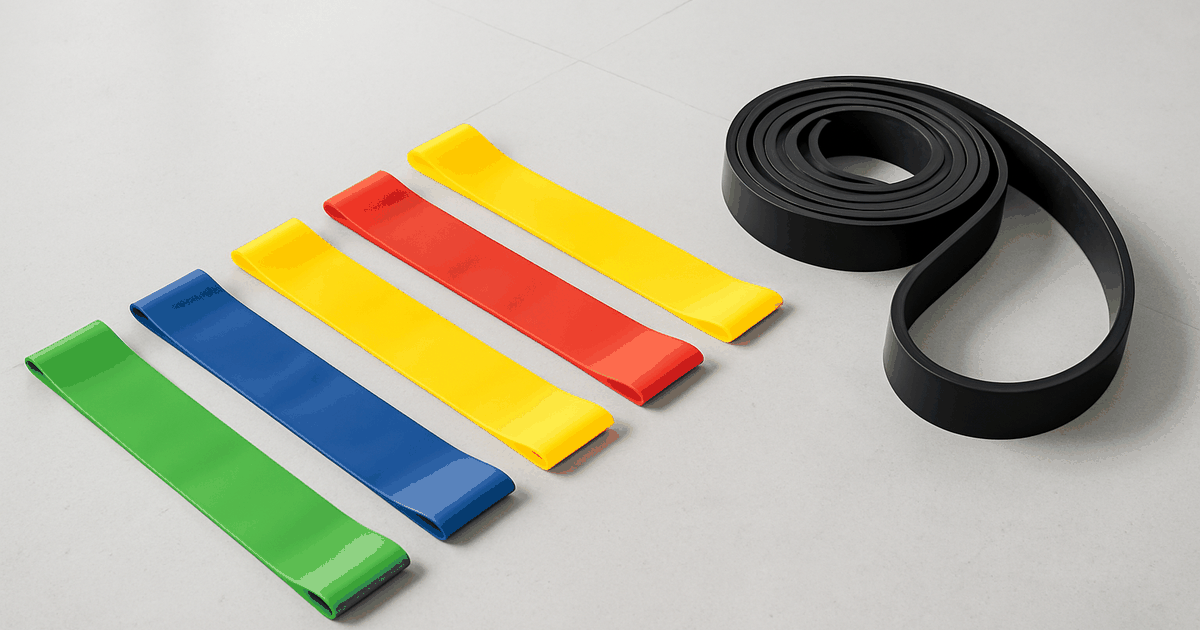
"Loop band" covers two products that are not interchangeable. Both are continuous loops with no handles, but they are built on opposite principles.
| Mini loop band | Long loop / power band | |
|---|---|---|
| Circumference | 600 mm (~12″ flat) | 2080 mm (~41″ flat) |
| Width | 50 mm (fixed) | 6.4–101 mm (variable) |
| Thickness | 0.4–1.2 mm (variable) | 4.5 mm (fixed) |
| Resistance set by | Thickness | Width |
| Range | 5–40 lbs | 5–260 lbs |
| Worn / anchored | Around thighs, ankles, wrists | Anchored to rack, door, or underfoot |
| Best at | Hip abduction, glute activation, shoulder health | Rows, presses, assisted pull-ups, deadlift assistance |
TAICLET production specs, ±3% dimensional tolerance. Full range: mini loop bands and long loop power bands. If you are deciding which to stock, our mini vs long band comparison covers the commercial side.
Which Resistance Level for Which Job
The mistake we see most often — in reviews, in returns data, and in the questions buyers send us — is starting too heavy. Lateral hip work generates far more load than people expect, and a band that is too strong simply moves the work into the wrong muscles.
| Mini loop level | Thickness | Rated | Use it for |
|---|---|---|---|
| X-Light (green) | 0.4 mm | 5 lbs | Warm-ups, rehab, shoulder external rotation |
| Light (blue) | 0.6 mm | 10 lbs | Best beginner default — clamshells, monster walks |
| Medium (yellow) | 0.8 mm | 20 lbs | Banded squats, glute bridges, lateral walks |
| Heavy (red) | 1.0 mm | 30 lbs | Loaded hip thrusts, ankle-position abduction |
| X-Heavy (black) | 1.2 mm | 40 lbs | Advanced athletes, sprint and skate drills |
Ratings are peak force at the manufacturer's rated stretch. Read how band force is actually measured before comparing these numbers with another brand's — colour codes are not standardised across brands.
Building a band set for retail or a gym? We supply calibrated 5-level loop sets in seven gradient colourways, MOQ 1,000 sets. Request samples and the force test report.
Lower Body: 5 Loop Band Exercises
1. Banded squat. Mini loop just above the knees, feet shoulder-width. Squat to depth while actively pushing the knees out against the band. 3 × 12–15, medium band. The band's job here is not to make the squat harder — it is to stop the knees collapsing inward.
2. Banded glute bridge. Mini loop above the knees, lying supine, heels close to your seat. Drive the hips up, press outward against the band at the top, pause two seconds. 3 × 15, medium to heavy.
3. Lateral band walk. Band above the knees or at the ankles, quarter-squat position, feet never coming together. 3 × 12 steps each direction, light to medium. Moving the band from knee to ankle raises the demand sharply at the same band rating — that is lever arm, not band strength.
4. Standing hip abduction. Mini loop at the ankles, hold a wall for balance, lift one leg out to the side with a straight knee and no torso lean. 3 × 15 per side, light to medium.
5. Banded good morning. Long loop band under both feet, top of the loop behind the neck. Hinge at the hips with a flat back until you feel the hamstrings load, then stand. 3 × 12, 13 mm or 21 mm band.
Glutes and Hips: 4 Loop Band Exercises
6. Clamshell. Mini loop above the knees, side-lying with hips and knees bent 45 degrees. Open the top knee without rolling the pelvis backward — that roll is the single most common fault. 3 × 15 per side, x-light to light.
7. Fire hydrant. Band above the knees, on all fours. Lift one knee out to the side, keeping the hips square. 3 × 12 per side, light.
8. Monster walk. Band at the ankles, walk forward in a wide diagonal stagger, then backward the same way. 3 × 15 steps each direction, light to medium.
9. Banded kickback. Band around both mid-feet, on all fours or standing. Extend one leg straight back, squeeze at the top, control the return. 3 × 12 per side, medium. See our full glute band programme for progressions.
Upper Body: 4 Loop Band Exercises
10. Band pull-apart. Long loop band, arms extended at chest height, pull the band apart until it touches the sternum. 3 × 15–20, 6.4 mm or 13 mm. The single best-value shoulder-health movement in the list.
11. Banded row. Long loop anchored at chest height on a rack or door anchor. Step back to take up slack, row to the ribs with the elbows tight. 3 × 12, 13–21 mm.
12. Overhead press. Long loop under both feet, hands at shoulder height, press to lockout. 3 × 10–12, 13 mm to start. Band force climbs as you press, so lockout is the hard part — the opposite of a barbell.
13. Shoulder external rotation. Mini loop around both wrists, elbows pinned to the ribs at 90 degrees, rotate the forearms outward. 3 × 15, x-light. Slow. This is a rehab movement, not a strength movement.
Core: 3 Loop Band Exercises
14. Pallof press. Long loop anchored at chest height to one side. Hold the band at the sternum, press straight out, resist the rotation. 3 × 10 per side, 13 mm. Anti-rotation — the pattern most band workouts leave out.
15. Dead bug with band. Mini loop around both feet, supine, hips and knees at 90 degrees. Extend one leg while the other resists the band's pull. 3 × 10 per side, light.
16. Banded mountain climber. Mini loop around both mid-feet, plank position, drive knees alternately toward the chest. 3 × 20 total, light to medium.
The 20-Minute Full-Body Loop Band Circuit
Three rounds, 40 seconds work and 20 seconds rest per station, 60 seconds between rounds. Use the mini loop for stations 1–4 and the long loop for stations 5–7.
| # | Exercise | Band | Pattern |
|---|---|---|---|
| 1 | Banded squat | Mini, medium | Squat |
| 2 | Glute bridge | Mini, medium | Hip hinge |
| 3 | Lateral band walk | Mini, light | Lateral hip |
| 4 | Dead bug | Mini, light | Anti-extension core |
| 5 | Banded row | Long, 13–21 mm | Horizontal pull |
| 6 | Overhead press | Long, 13 mm | Vertical press |
| 7 | Pallof press | Long, 13 mm | Anti-rotation |
Three rounds ≈ 21 minutes including rest. For a handle-and-tube version of the same structure, see the full-body tube band workout guide.
Why the Same Band Feels Different in Different Exercises
This is the part that almost no training article explains, and it is the reason "20 lb band" causes so much confusion.
Band force is a function of elongation percentage — how far the band stretches relative to its own resting length — not of how far your limbs travel. Run the numbers on the same 8 inches of travel:
| Band | Flat resting length | Stretched by | Elongation |
|---|---|---|---|
| Mini loop | ~12″ | 8″ | ~67% |
| Long loop | ~41″ | 8″ | ~20% |
Same movement, same 8 inches, and the mini loop is more than three times further along its force curve. Published laboratory measurements on therapy band show the same effect within a single band: force at 200% elongation runs roughly 3–4× the force at 25% elongation for every colour tested.
Three practical rules fall out of this:
- Short travel, use a mini loop. Clamshells and lateral walks move a few inches. A long loop barely stretches over that range and does almost nothing.
- Long travel, use a long loop. A row or press moves 18–24 inches. A mini loop would be at 150%+ elongation and near its limit.
- Band ratings are a peak, not a constant. A "30 lb" band may deliver 10 lbs at the start of the rep. Ranges printed as "15–35 lbs" are the honest format.
The Four Mistakes That Snap Loop Bands
We test returned bands, and the failures cluster into the same four causes almost every time:
- Anchoring on an unfiled edge. A rack upright with a sharp machined corner cuts a micro-nick on the first rep. Under load, that nick propagates. Wrap the anchor point or use a sleeve.
- Exceeding rated stretch. Long loop bands are rated to a maximum extension. Standing on the band with a wide stance and pressing overhead can push past it.
- Shoe abrasion. Bands run under trainers pick up grit that acts like sandpaper on every rep. Wipe the band, not just the floor.
- UV and ozone exposure. Natural rubber bands stored on a sunny windowsill crack from the surface inward. Our materials guide explains why the TPE backbone is immune to this and latex is not.
Our TPE loop bands hold force within 10% after 10,000+ stretch cycles in accelerated testing, but that number assumes a clean anchor. Full detail on failure modes and replacement scheduling is in why resistance bands snap.
Frequently Asked Questions
What are the best loop band exercises for a full-body workout?
Cover six patterns: squat, hip hinge, lateral hip, horizontal pull, press or pull-apart, and anti-rotation core. The 20-minute circuit above runs all six in seven stations.
What is the difference between a mini loop and a long loop band?
Mini loops are ~600 mm around, 50 mm wide, and get their resistance from thickness (0.4–1.2 mm, 5–40 lbs). Long loops are ~2080 mm around at a fixed 4.5 mm thickness and get their resistance from width (6.4–101 mm, 5–260 lbs).
Why does the same band feel harder in some exercises?
Force follows elongation percentage. The same 8 inches of travel is ~67% elongation on a mini loop and ~20% on a long loop.
Which resistance should a beginner buy?
A light (0.6 mm, ~10 lb) mini loop and a 13 mm long loop cover most beginner work. Buy a five-level set rather than one heavy band.
Can you build muscle with loop bands?
Yes, taking sets near failure and progressing by level, reps, or eccentric tempo. The ceiling is lower than a barbell for heavy lower-body work, so most lifters use loop bands for hip, shoulder, and accessory training.
Should the band sit above or below the knees?
Start above the knees. Moving it to the ankles lengthens the lever arm and increases gluteus medius demand at the same band rating. Never place a band over the kneecap.
How often can you train with loop bands?
Three to five sessions a week, with light hip and shoulder work daily as a warm-up. Inspect bands weekly for nicks; commercial and clinical users typically replace on a 6–12 month cycle.
Do loop bands wear out faster than tube bands?
They fail differently. No hardware to break, but the whole surface is exposed to abrasion. A single edge nick is the usual starting point for a tear.
Related Guides
- Mini Loop Bands vs Long Resistance Bands: Which to Stock
- Resistance Band Glute Exercises: Full Programme
- Resistance Band Size Guide: Length, Width & Thickness
- Resistance Band Color Code Weight Chart (lbs & kg) — SPRI, TheraBand + 5 brands
- Resistance Band Weight Chart kg & lbs — find the right resistance by exercise
- How to Measure Resistance Band Weight: The Factory Test Method
- What Are Resistance Bands Made Of? Latex, Rubber & TPE
- TPE vs Latex: 11 Key Differences for Resistance Bands
- TPE Mini Loop Bands — 7 Gradient Colourways, MOQ 1,000 Sets
Stocking Loop Bands for Retail, Gyms or Clinics?
TAICLET manufactures latex-free TPE mini loop and power bands from our own compound, force-tested per batch. Custom resistance calibration, colour, print and packaging. MOQ from 1,000 sets, samples in 7–10 days.