
What Are Resistance Bands Made Of? Latex, Rubber, TPE and Fabric Explained
Published 2026-09-08 · 11 min read · Materials Guide
Quick answer: almost every resistance band on the market is one of four materials — natural rubber latex (tree sap, vulcanised with sulphur), TPE (a synthetic, latex-free thermoplastic elastomer), fabric (a woven polyester shell over elastic threads), or a synthetic rubber such as polychloroprene. Latex and natural rubber are not two materials — they are the same material in liquid and solid form. TPE is the only one of the four that is genuinely a plastic-family polymer, and it is the only one that is guaranteed latex-protein-free.
We get this question in writing several times a month, usually from a hospital procurement officer or a school district buyer who has been told to source "latex-free" and is trying to work out whether the sample in front of them qualifies. TAICLET is a TPE resistance band manufacturer running compounding through to finished goods, so this guide is written from the material side of the business rather than the marketing side.
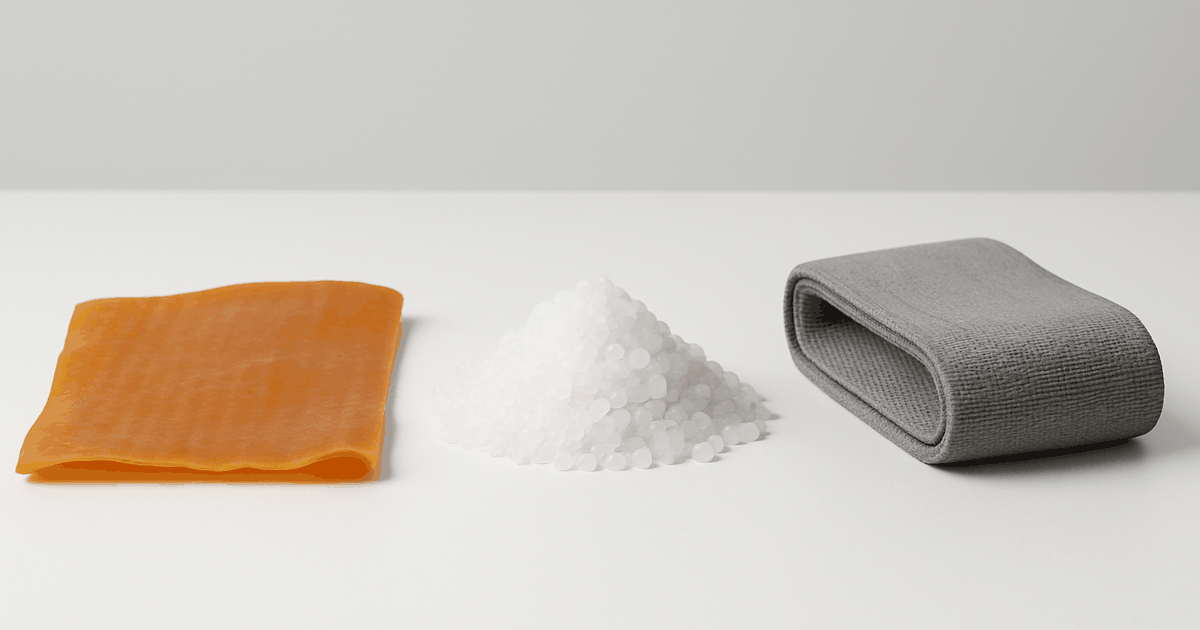
Latex vs Rubber: Same Material, Two Different Stages
This is the single most common confusion, and it is easy to clear up.
Latex is the liquid. Cut the bark of a Hevea brasiliensis tree and a milky white fluid runs out. That fluid is latex: a colloidal suspension of rubber particles in water, typically 30–40% dry rubber content as tapped, concentrated by centrifuge to around 60% DRC for shipping. The rubber particles themselves are cis-1,4-polyisoprene, roughly 94% of the dry solids, with the balance being proteins, lipids, and sugars.
Rubber is the solid. Coagulate that latex with acid, roll it, dry it, and you have a sheet of natural rubber. Cross-link it with sulphur at heat — vulcanisation, unchanged in principle since 1839 — and you have the springy, tear-resistant material a band is cut from.
So: every natural rubber band began life as latex. When a buyer asks "is this latex or rubber?", the honest answer is that if it is natural rubber, it is both, and it carries the same allergy risk either way. The question they actually mean is "does this contain natural rubber latex proteins?" — and that is a yes/no that belongs on a specification sheet.
| Term | What it actually means | Contains latex proteins? |
|---|---|---|
| Natural rubber latex | Liquid tree sap, uncured | Yes |
| Natural rubber (NR) | The same sap, coagulated and vulcanised | Yes |
| Synthetic latex | SBR or polychloroprene dispersion, petroleum-derived | No |
| TPE / TPR | SEBS or SBS block copolymer, melt-processed | No |
| Elastane / spandex | Polyurethane-polyurea fibre | No |
"Latex-free" is a claim about the third column only. It says nothing about strength, feel, or price.
Is Latex a Plastic?
No. Natural rubber latex is a biopolymer — a tree makes it. Plastics are synthesised from petrochemical feedstock. They sit in different families entirely.
The confusion is understandable, because the material that replaced latex in most modern bands is from the plastics family. TPE (thermoplastic elastomer) is engineered to behave like rubber at room temperature while processing like plastic at heat. There is a one-line test that separates them for good:
- Vulcanised natural rubber is a thermoset. Sulphur cross-links are permanent chemical bonds. Heat it and it degrades and chars — it will never melt back into a usable form. Production scrap is waste.
- TPE is a thermoplastic. Its "cross-links" are physical: hard polystyrene domains that lock the soft rubbery mid-blocks in place. Heat softens those domains, the material flows, cooling re-forms them. Scrap goes back into the extruder.
That is not a trivia point. It is the reason our factory floor can reprocess trim waste instead of skipping it, and it is a large part of why TPE band pricing has converged with latex over the last five years.
Sourcing for a hospital, clinic or school district? We supply a written material declaration and antigenic-protein test result with every latex-free order. Request the material spec pack.
The Four Materials, Side by Side
Here is what the four families actually do once they are a finished band. The figures below are the ranges we hold on our own production and the values we see on incoming competitor samples we test for comparison.
| Property | Natural rubber latex | TPE (SEBS) | Fabric (shell + core) |
|---|---|---|---|
| Elongation at break | 600–900% | 700–900% | 80–150% (shell limited) |
| Tensile strength | 3,000–4,500 psi | ≥3,500 psi (our spec) | Governed by weave |
| Shore A hardness | 30–45 | 25–45 (tunable) | n/a |
| Ozone / UV resistance | Poor — backbone double bonds | Excellent — saturated backbone | Good (shell protects core) |
| Latex allergy risk | Yes | None | Depends on core |
| Recyclable scrap | No (thermoset) | Yes | No |
| Typical FOB China | $0.25–0.80/pc | $0.30–0.90/pc | $1.50–4.00/pc |
Tensile and elongation measured per ASTM D412; hardness per ASTM D2240; ozone behaviour per ASTM D1149. FOB ranges are for 1,000+ piece orders, 2026 pricing, and move with dimensions and packaging.
The row that decides most sourcing arguments is ozone and UV resistance. Natural rubber's polyisoprene backbone is full of carbon-carbon double bonds, and ozone attacks double bonds. That is why a latex band left on a sunny windowsill or near a motor develops fine surface cracks and then fails without warning. The SEBS backbone is saturated — no double bonds in the rubbery mid-block — so there is nothing for ozone to grab. In accelerated ageing at 70°C for 168 hours, our TPE compounds retain ≥80% of original force.
What Is Thera-Band Made Of?
The classic Thera-Band flat exercise band and tubing line is natural rubber latex. That surprises a lot of clinical buyers, because the brand is so embedded in physiotherapy that people assume it must already be hypoallergenic. The manufacturer does produce a separate non-latex line in a synthetic elastomer, sharing the same colour progression.
Two practical consequences:
- The colour code carries over, the material does not. A yellow band in either line sits at the same point on the resistance ladder — see our resistance band colour code chart for the full progression in lbs and kg — but only one of the two is latex-free.
- Purchase orders need the line, not the brand. "Thera-Band yellow, 50 yd" is not a complete specification for a latex-free facility. We have seen more than one hospital take delivery of the wrong line on exactly that wording.
If you are evaluating substitutes, our Thera-Band alternative comparison lays out how TPE therapy bands map onto the same force ladder.
Is Natural Rubber Toxic?
Cured natural rubber is not toxic in the everyday sense — it is used in baby bottle teats, surgical tubing, and food handling equipment. But "not toxic" and "safe for every user" are different claims, and two real issues sit underneath the question.
1. Allergenic proteins. Natural rubber latex carries residual plant proteins, catalogued as Hev b 1 through Hev b 13, which provoke Type I (IgE-mediated) allergic responses in sensitised people. Reactions range from contact urticaria to anaphylaxis. Sensitisation rates are far higher in populations with repeated exposure — healthcare workers and patients with spina bifida are the two classic high-risk groups — which is why hospital and school specifications went latex-free long before consumer fitness did. The relevant test is ASTM D6499, an immunological assay for antigenic protein content.
2. Vulcanisation chemistry. Rubber does not cure by itself. Accelerators are added, and some in the thiuram and dithiocarbamate families can generate N-nitrosamines during cure. This is a well-known compliance area with established limits for products intended for children and for food contact, and it is why serious factories run low-nitrosamine accelerator packages and test for it.
TPE sidesteps both. There are no plant proteins to remove and no sulphur cure to run, so there is no accelerator chemistry to control. For a classroom chair band that thirty children will handle daily, that is the whole argument in one sentence.
What Fabric Resistance Bands Are Actually Made Of
Fabric bands — the wide non-slip hip bands used for glute work — are a composite, not a single material:
- Shell: woven polyester or nylon, often with a silicone grip print on the inner face.
- Core: parallel elastic threads running the length of the band. This is where the material question lives.
Those core threads are frequently natural rubber latex. A "fabric" band is therefore not automatically latex-free — a distinction that matters enormously if you are supplying a clinic. Bands built on elastane (spandex) cores are genuinely latex-free; elastane is a polyurethane-polyurea copolymer with no botanical origin and no shared allergen profile with latex.
You cannot tell from the outside. Ask for the core material on the spec, not the shell. Our fabric vs TPE vs latex comparison goes through the trade-offs in feel, durability, and price.
How We Choose Material on the Factory Floor
Every product line on our floor gets a material assigned by application, not by preference:
| Application | Material we run | Why |
|---|---|---|
| School chair / fidget bands | TPE | Latex-free is a district requirement; daily abrasion |
| Clinic therapy bands | TPE | Patient allergy exposure; repeatable force ladder |
| Mini loop bands | TPE | Colour consistency, no bloom, tunable Shore A |
| Heavy pull-up bands | TPE or layered NR | High peak load; NR still has a following at 80 lb+ |
| Hip / booty bands | Fabric, elastane core | Non-slip requirement; latex-free by construction |
Two things buyers routinely underestimate. First, compound family is not the whole story — SEBS and SBS are both "TPE", but SBS has an unsaturated backbone and ages far worse. If a quotation just says "TPE", ask which. Second, colour is a pigment decision, not a material one. We can produce any colour in any compound, which is exactly why colour tells a buyer nothing about what a band is made from.
How to Verify Material Before You Buy
Three checks, in ascending order of rigour:
- Smell. Natural rubber has a distinct sulphur-and-ammonia note that never fully leaves. TPE is close to odourless. This catches most mislabelling in about four seconds.
- Stretch and release. Latex snaps back hard and, over months, develops a faint white surface bloom as antiozonants migrate out. TPE returns slightly slower with a softer, waxier surface and no bloom.
- Paperwork. This is the only one that survives an audit. Ask for the items below.
| Document | What it proves |
|---|---|
| Material declaration | Compound family and grade (e.g. SEBS-based TPE, not just "TPE") |
| ASTM D6499 report | Antigenic latex protein content — the only real proof of "latex-free" |
| ASTM D412 tensile report | Tensile strength and elongation at break, batch-specific |
| RoHS / Prop 65 statement | Heavy metals and restricted substances for US and EU entry |
| Force test report | Resistance at a stated elongation, per colour, per batch |
A supplier who cannot produce the first two is not testing — they are repeating what their own raw material vendor told them. Learn how force is actually measured before you accept a force report at face value.
Frequently Asked Questions
What are resistance bands made of?
Natural rubber latex, TPE, fabric over an elastic core, or a synthetic rubber such as polychloroprene. Therapy bands and heavy pull-up bands lean latex; modern loop bands, tubes, and school chair bands are predominantly TPE.
Is latex the same as rubber?
Yes, at different stages. Latex is the liquid sap (30–40% dry rubber content as tapped); rubber is the coagulated, vulcanised solid. Both carry latex proteins.
Is latex a plastic?
No — it is a tree-produced biopolymer, cis-1,4-polyisoprene. TPE is the plastic-family material that mimics it.
What is Thera-Band made of?
The standard line is natural rubber latex. A separate non-latex line exists, using a synthetic elastomer and the same colour code. Specify the line, not just the brand.
Is natural rubber toxic?
Not in the ordinary sense. The two genuine concerns are residual Hev b allergenic proteins and nitrosamine-forming vulcanisation accelerators. TPE has neither.
Are fabric resistance bands latex-free?
Only if the elastic core is elastane or a synthetic elastomer. Many fabric bands use latex threads inside a polyester shell.
Is TPE rubber?
It behaves like rubber but is chemically a thermoplastic block copolymer. Its cross-links are physical and reversible, so it can be remelted; vulcanised rubber cannot.
Does TPE contain latex?
No. TPE is synthesised from petrochemical feedstock and contains no natural rubber latex and no Hev b proteins. See our latex-free buyer's guide.
Related Guides
- TPE vs Latex Resistance Bands: Strength, Durability & Cost Compared
- Latex-Free Resistance Bands: Complete TPE Buyer's Guide
- Non-Latex Rubber Bands: Best Latex-Free Alternatives
- TPE Rubber: SEBS vs SBS, Shore A Hardness & Safety
- How Resistance Bands Are Made: The Factory Process
- TPE Mini Loop Bands — Wholesale & OEM
Need Documented Latex-Free Bands?
TAICLET compounds its own SEBS-based TPE and ships a material declaration, antigenic protein result and batch force report with every order. Custom resistance, colour, width and branding. MOQ from 1,000 pieces.