
Band Tension Chart for Squat, Bench Press and Deadlift: How Much Do Bands Really Add?
Published 2026-10-13 · Last Updated: 2026-10-13 · 12 min read · Strength Training
Quick answer: a band adds whatever force it produces at the stretch your setup creates, so the label number is only a starting point. As working estimates, a 1.25-inch (32 mm) band adds about 20-30 lb per side at the top of a squat, a 2.5-inch (64 mm) band about 45-55 lb per side, and a 4-inch (101 mm) band about 110-130 lb per side, falling to near zero at the bottom if the band is just taut there. For accommodating resistance, aim for total band tension at lockout of about 15-25% of your one-rep max, and measure your own rack with a luggage scale before you program from any chart.
Key takeaways
- Stretch, not colour, sets the tension. Band force at a given width rises with how far the band is stretched beyond its resting length.
- Same width ≠ same tension. A 2019 study of 141 bands from four major distributors found differences of -37% to +16% between bands of similar thickness.
- A 64 mm band at 100% stretch measured about 41-45 kg (90-98 lb) in that study, a useful anchor for the most common barbell band.
- The 25% rule: Westside Barbell's guidance puts total band tension at lockout near 25% of 1RM; research protocols used 15-35%.
- Pair your bands. Mismatched sides make the bar tilt. Buy same-lot pairs and measure them.
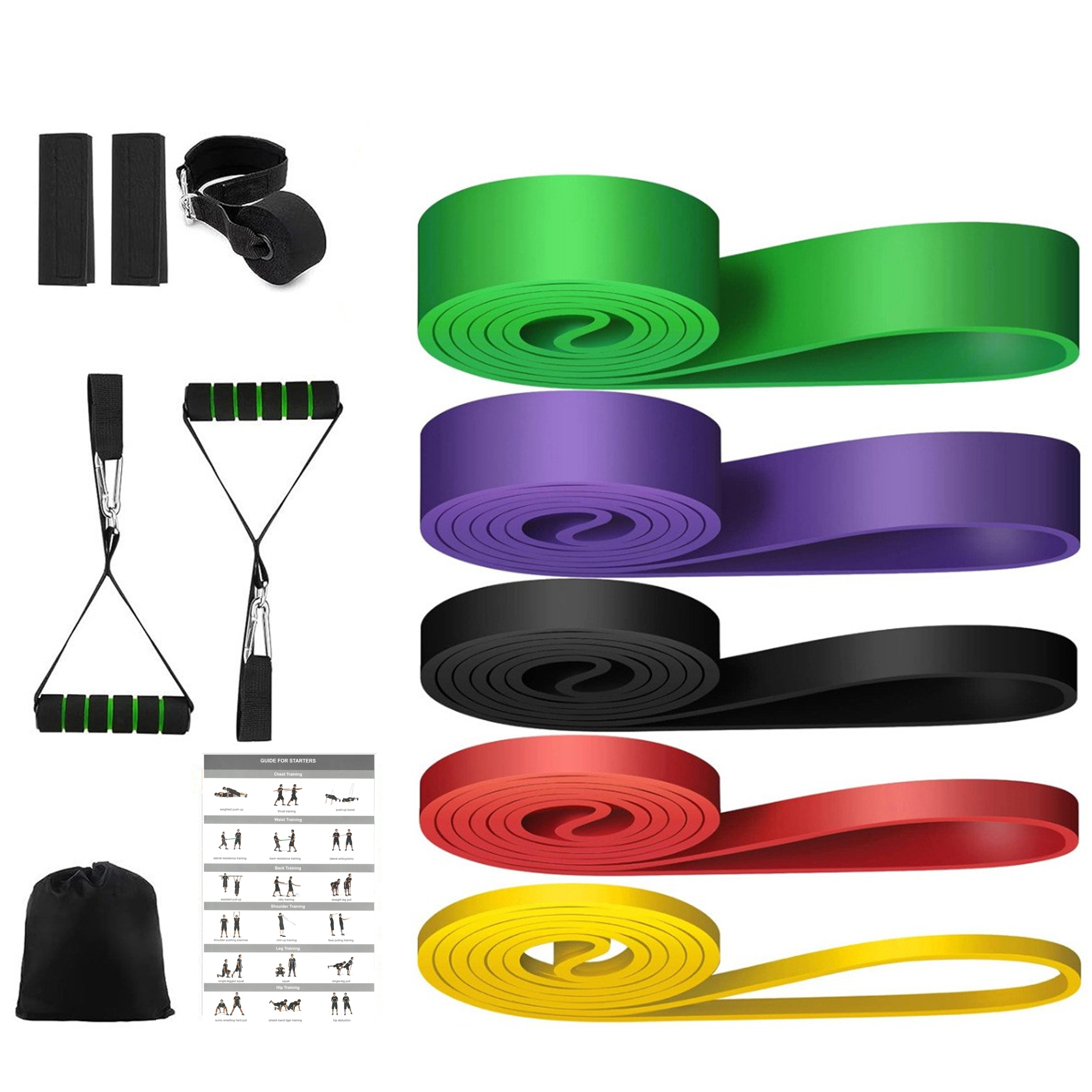
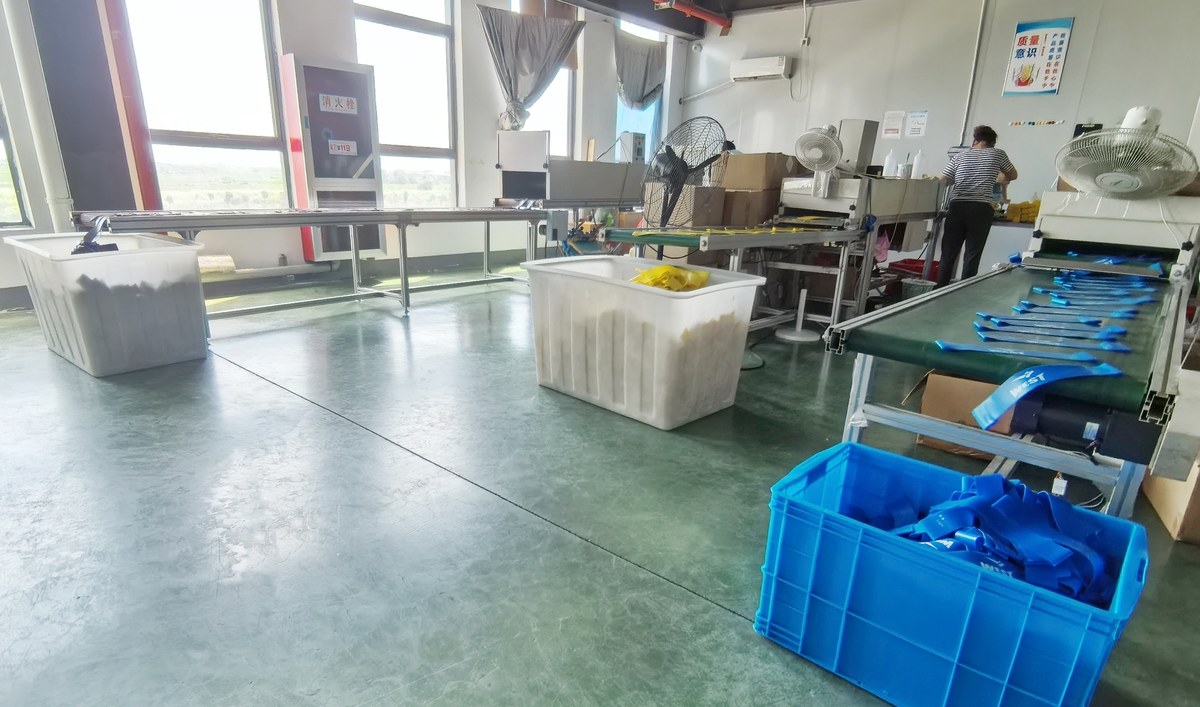
We make TPE loop bands in Danyang, Jiangsu: six extrusion lines, 30 million+ bands a year, from 6.4 mm to 101 mm wide. The same 41-inch loop that a commercial gym hangs on a pull-up bar ends up choked around the pegs of a power rack, and the question we hear from gym owners and strength coaches is always the same: "How much does this band actually add to the bar?" The honest answer is that the band doesn't decide that on its own. Your rack does. This guide shows how to get a real number.
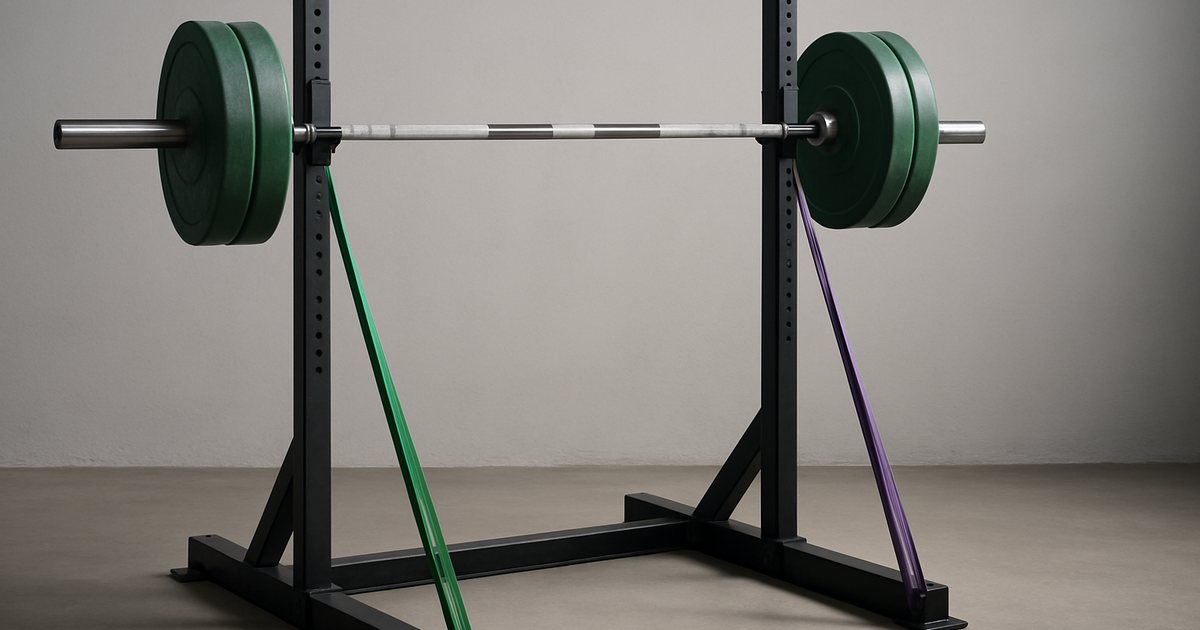
Why Band Ratings Don't Tell You Barbell Tension
Every loop band on the market is sold with a number or range: "50-125 lb", "Green = 80 lb", "Heavy". For assisted pull-ups that's a fine sizing guide. For a barbell, it's nearly meaningless, for three reasons.
- Force depends on elongation. Rubber and TPE bands follow a rising force curve. Lab data on therapy bands shows the same band producing 3-4x more force at 200% stretch than at 25%. We go through that curve in our guide to how to measure resistance band weight.
- Ratings don't state their stretch. Most catalogue numbers, ours included, are sizing classes for bodyweight use. They aren't load-cell readings at a defined elongation, so two "80 lb" bands from two brands are not comparable.
- Your rack sets the stretch. Peg height, how many times the band is wrapped, and the lifter's height and range of motion decide how far the band stretches at lockout. The same band can add 30 lb in one setup and 70 lb in another.
That's why Westside Barbell, whose system made banded lifting mainstream, tells lifters that its own per-side tension numbers only apply to its pegs and rack geometry, and to check with a scale.
Measured Band Tension by Width (lbs and kg)
The best independent data comes from Fuentes, Smith and Shoepe, "Loading Patterns of Rubber-Based Resistance Bands across Distributors" (Sports, 2019, 7(1):21). They stretched 141 bands from EliteFTS, Power Systems, RubberBanditz and Rogue Fitness around an Olympic barbell anchored to a squat rack, from a 100 cm resting length to 200 cm (100% elongation), recording force on a load cell every 5 cm. Their reliability was excellent (grand mean ICC 0.99), so the spread below is real band-to-band variation, not measurement noise.
| Band width | Closest TAICLET size | Mean force at 100% stretch, by distributor | In lb | Typical barbell use |
|---|---|---|---|---|
| 0.25 in (6.35 mm) | 6.4 mm (yellow) | 3.8-4.6 kg | 8-10 lb | Warm-up, bench "mini" doubled |
| 0.5 in (12.7 mm) | 13 mm (red) | 8.0-9.6 kg | 18-21 lb | Light bench, technique work |
| 2.5 in (63.5 mm) | 64 mm (blue) | 40.9-44.6 kg | 90-98 lb | Squat, deadlift, heavy bench |
| 4 in (101.6 mm) | 101 mm (gray) | 95.9-106.7 kg | 211-235 lb | Squat and deadlift only, advanced |
Source: Fuentes AD, Smith CJ, Shoepe TC, Sports (Basel) 2019;7(1):21, Table 2, mean force at 200 cm for 100 cm bands. Values are for the whole loop at 100% elongation. Latex bands; TPE bands of the same width differ slightly, which is one more reason to measure.
Two findings matter more than the averages. First, the distributor effect was statistically significant at every width except one. Second, bands of similar thickness ranged from -37% to +16% around their group mean, and the widest bands had the widest absolute spread (one distributor's 4-inch bands ran from 97.8 to 113.9 kg). The authors' practical advice: label every band individually and track it, the way you'd track a calibrated plate.


How to Estimate Tension for Your Own Rack
You can get within about 20% of the real number with a tape measure and the table above. The method uses a straight-line approximation of the force curve: real bands are a little stiffer early in the stretch, so treat the result as a planning number, then confirm with a scale.
- Find the band's stiffness. Divide the force at 100% stretch by the stretch distance. A standard 41-inch band is a 208 cm loop that lies flat at about 104 cm, so its free length on a bar is roughly 100 cm, and a 64 mm band at roughly 42 kg over 100 cm gives about 0.42 kg per cm of stretch (about 0.93 lb per cm).
- Find the stretch at the bottom. Measure from the peg (or dumbbell handle) to the bar sleeve with the bar at the bottom of your rep. Subtract the band's free length after wrapping. If the result is negative, the band is slack at the bottom.
- Find the stretch at lockout. Add your range of motion: the distance the bar travels from bottom to top.
- Multiply. Tension per side ≈ stiffness × stretch. Double it for both sides of the bar.
Worked example (squat). A lifter's bar travels 55 cm from parallel to lockout. They choke a 64 mm band around a low peg so it's just taut with the bar at parallel. At lockout the band has stretched 55 cm: 0.42 × 55 ≈ 23 kg, or about 51 lb per side, 102 lb total. Wrapping the band once more around the peg takes up slack and pre-stretches it. If that adds 15 cm of stretch at the bottom, the lifter now gets about 14 lb per side at the bottom and about 65 lb per side at the top.
| Lift (typical bar travel) | 32 mm band | 64 mm band | 101 mm band |
|---|---|---|---|
| Bench press (~40 cm) | ~15-20 lb/side | ~35-40 lb/side | Too heavy for most |
| Squat (~55 cm) | ~20-30 lb/side | ~45-55 lb/side | ~110-130 lb/side |
| Deadlift (~50 cm) | ~20-25 lb/side | ~40-50 lb/side | ~100-120 lb/side |
Estimated added tension at lockout with the band just taut at the bottom, using the linear method above and the 2019 study's mean forces. The 32 mm values are interpolated between measured widths. Pre-tensioning (extra wraps, higher pegs) raises both the bottom and top numbers. Bands at the light end of a brand's range read low, so confirm with a scale.
Equipping a gym or building a band line?
We supply loop bands from 6.4 mm to 101 mm in matched colours, with custom Pantone colours from 500 pcs per colour and your logo printed on the band. Tell us your rack setup and we'll suggest the width ladder.
See Pull-Up & Power Band SizesMeasure It: The Luggage-Scale Method
Five minutes with a $15 digital luggage scale beats any chart, including ours.
- Set the bands up exactly as you'll lift: same pegs, same wraps, same sleeve position.
- Unload the bar, or use an empty bar in the safeties at your bottom position.
- Hook the luggage scale to the band where it loops over the sleeve, and pull straight up to your lockout height. Read the force. That's the per-side tension at the top.
- Repeat at your bottom height. That's the tension in the hole. If it's zero, the band is slack and will snap taut mid-rep, so add a wrap.
- Repeat on the other side. If the two sides differ by more than about 5%, swap bands until they match.
- Write the two numbers on a strip of tape on the band, or on the rack. Re-check every few months: bands relax with use.
Most lifters skip step 4 and only find out the band was slack at the bottom when the bar jerks out of the hole. If you program for clients, keep the measured numbers in their log: "64 mm, low pegs, double wrap: 18 lb bottom / 62 lb top per side" is a reproducible prescription. "Blue band" is not.
How Much Band Tension to Use: Programming by % of 1RM
Bands are a tool for accommodating resistance: the load rises as you move into the stronger part of the lift. Speed and lockout strength both benefit. Here's how coaches and researchers have dosed it.
| Goal | Bar weight | Band tension at lockout (total) | Example: 400 lb squat 1RM |
|---|---|---|---|
| Introduction / technique | 50-60% 1RM | 10-15% 1RM | 220 lb bar + 40-60 lb bands (32 mm pair) |
| Speed / dynamic effort | 50-60% 1RM | ~25% 1RM | 220 lb bar + ~100 lb bands (64 mm pair, just taut) |
| Advanced speed work | 50% 1RM | ~33% 1RM | 200 lb bar + ~130 lb bands (64 mm, extra wrap) |
| Heavy lockout overload | 70-85% 1RM | 15-20% 1RM | 300 lb bar + 60-80 lb bands |
The ~25% figure is Westside Barbell's published starting point for squat and bench speed work, with about a third used by more experienced lifters. The research uses the same range. A deadlift study by Manolovitz and colleagues in the Journal of Strength and Conditioning Research (2015) compared bands supplying 15% and 35% of total resistance at 60% and 85% of 1RM. Adding bands generally increased power and bar velocity while peak force dropped. Use that as your sign the dose is right: if bar speed slows visibly in the top half, the bands are too heavy for the bar weight.
Remember that your total load at lockout is bar plus bands. A 220 lb bar with 130 lb of band tension means 350 lb at the top, 88% of a 400 lb max, even though the bar "only" weighs 55%. Treat the top position with respect, and keep safeties set. If you're comparing bands with plates more generally, see our resistance bands vs weights comparison.
Setup by Lift: Squat, Bench Press, Deadlift
Squat. Anchor each band to a low peg or the rack base, run it up and loop it over the sleeve between the collar and the plates. The loop length means bands are often slack at parallel on a standard rack, so choke the band around the peg once or twice until it is taut with the bar in the hole. Walk the bar out straight back: bands pull the bar toward the anchor line, so stay in the rack footprint.
Bench press. The bar travels only about 40 cm, and the anchor is far below the bench, so the band runs long. Double it around a low peg or a heavy dumbbell on each side. Lighter bands (13-32 mm) are usually enough: a pair of 64 mm bands set just taut adds 70-80 lb at lockout, which is a lot on a 250 lb bench.
Deadlift. Stand on the band (or run it under a loaded platform or around heavy dumbbells) and loop it over the sleeve. Because the bar starts on the floor, the band is usually already stretched at the start, so measure the bottom as well as the top. Reverse bands, hung from the top of the rack, do the opposite: they help most at the floor and fade toward lockout.
On all three lifts, keep the band off the knurling and away from sharp peg edges. A band dragged across knurling under load can nick, and a nick is where a band fails. Our guide on why resistance bands snap covers inspection and retirement.
TPE vs Latex Bands for Barbell Work
Most powerlifting bands are layered natural latex. TPE bands are the latex-free alternative. Here's how they compare in a rack.
| Factor | Layered latex | Extruded TPE (SEBS) |
|---|---|---|
| Snap-back / rebound | Very high; the classic "fast" band | High, slightly more damped |
| Latex allergy risk | Yes; an issue in shared gyms and clinics | None, latex-free |
| Ozone / UV ageing | Sensitive; cracks if stored in sun | Resistant |
| Barbell stretch range | 0-100% (well within limits) | 0-100% (we fatigue-test at 3x elongation, 10,000+ cycles) |
| Odour, powder | Ammonia smell, talc | Near odourless, no powder |
| Best fit | Competitive powerlifting gyms | Commercial gyms, studios, PT, latex-sensitive members |
The practical point: a rack setup stretches a 41-inch band to at most about double its folded length, far below the 3x stretch we use in fatigue testing. The failure risk in a rack comes from cuts and edges, not from the material running out of stretch. For the full material comparison, read TPE vs latex resistance bands.
For Gyms, Coaches and Brands: Specifying Barbell Bands
If you're equipping a facility or launching a band line, the 2019 data is your spec sheet's warning label: width alone doesn't guarantee tension. Write these into your purchase order:
- Force at a defined elongation. For example, "64 mm loop: 40 kg ±10% at 100% elongation (folded length 100 cm → 200 cm)". A number without a stretch is not a spec.
- Tolerance and sampling. We hold resistance within ±8% of nominal per batch. Ask for 5 pieces per width per batch on a calibrated force gauge, reported with the pre-shipment inspection. Our resistance band QC inspection checklist lists the full test plan.
- Matched pairs from one lot. Ask for bands to be packed in pairs from the same production lot, so both sides of a bar come from the same compound batch.
- Individual labels. The study's own recommendation. A printed width code or serial on each band makes tracking and replacement simple.
- A width ladder, not a colour story. Colours mean different things across brands (see our resistance band color code chart). Print the width and measured force on the band or tag.
For commercial buyers, our commercial gym resistance band guide covers quantities per rack, replacement cycles and hygiene, and OEM custom resistance bands covers colours, logos and packaging. MOQ is 1,000 sets (500 pcs per custom colour), with production in 15-25 days for custom colours.

Frequently Asked Questions
How much tension does a resistance band add to a squat?
It depends on the band width and how far the band stretches between the bottom and the top of the rep, not on the number printed on the label. As a working estimate, a 2.5-inch (64 mm) loop band that is just taut at the bottom of a 55 cm squat adds roughly 45-55 lb per side at lockout, or about 90-110 lb in total. A 4-inch (101 mm) band in the same setup adds roughly 110-130 lb per side. Measure your own setup with a luggage scale before programming from it.
How much band tension should I use for speed work or accommodating resistance?
Westside Barbell's published guidance puts total band tension at lockout around 25% of your one-rep max for squat and bench, with more advanced lifters going toward a third. Research protocols sit in the same range: a deadlift study in the Journal of Strength and Conditioning Research compared bands supplying 15% and 35% of the total load. Start at 15-25% and increase only when bar speed stays high.
Why does my band feel heavier than its rating on a barbell?
Because ratings and barbell tension are measured at different stretches. Band force rises with elongation, and a pull-up band rating is a sizing class rather than a force reading at a defined stretch. On a rack setup, peg height and how many times you wrap the band decide the stretch, so the same band can add 30 lb in one rack and 70 lb in another.
Do bands of the same width from different brands give the same tension?
No. Fuentes, Smith and Shoepe (Sports, 2019) tested 141 rubber bands from EliteFTS, Power Systems, RubberBanditz and Rogue Fitness and found significant differences between distributors at every width except one, with a spread of -37% to +16% between bands of similar thickness. They recommend labelling each band individually. Do not mix brands on the two sides of a bar.
Can TPE pull-up bands be used for banded squats and bench press?
Yes, within limits. In a typical rack setup a 41-inch loop band works between about 0% and 100% elongation, well below the 3x elongation at which we fatigue-test our TPE bands to 10,000+ cycles. Loop the band over the collar or sleeve, never over knurling or a sharp peg edge, inspect it for nicks before each session, and retire any band with a cut or a white stress mark.
Should I use the same band on both sides of the bar?
Use a matched pair: same brand, same width, same production lot, and ideally measured within 5% of each other at your working stretch. A 10% mismatch on a 100 lb per side setup puts a 10 lb lateral imbalance on the bar at lockout, which shows up as the bar tilting or drifting toward the stronger side.
Related Guides
- Pull-up assist bands: sizes and resistance levels
- How to measure resistance band weight
- Resistance band color code chart: weight in kg and lbs
- Why resistance bands snap, and how long they last
- Resistance bands for commercial gyms
Request a Quote for Power & Pull-Up Bands
Latex-free TPE loop bands, 6.4-101 mm wide, extruded in-house. Batch tension tested, RoHS and phthalate-free. Custom colours, logo printing and retail packaging. MOQ 1,000 sets, samples in 3-5 days.