
Quick Answer: Is Rubber Latex?
Yes, natural rubber IS latex. They come from the same source — the milky sap of theHevea brasiliensis rubber tree. "Natural rubber" and "natural latex" are essentially synonyms.TPE is completely different — it is a synthetic thermoplastic elastomer with zero connection to rubber trees, zero latex proteins, and zero allergy risk. Synthetic rubbers (EPDM, neoprene, SBR) are also different from natural rubber — they are petroleum-derived and latex-free, but they are thermosets (not recyclable), unlike TPE which is a thermoplastic (fully recyclable).
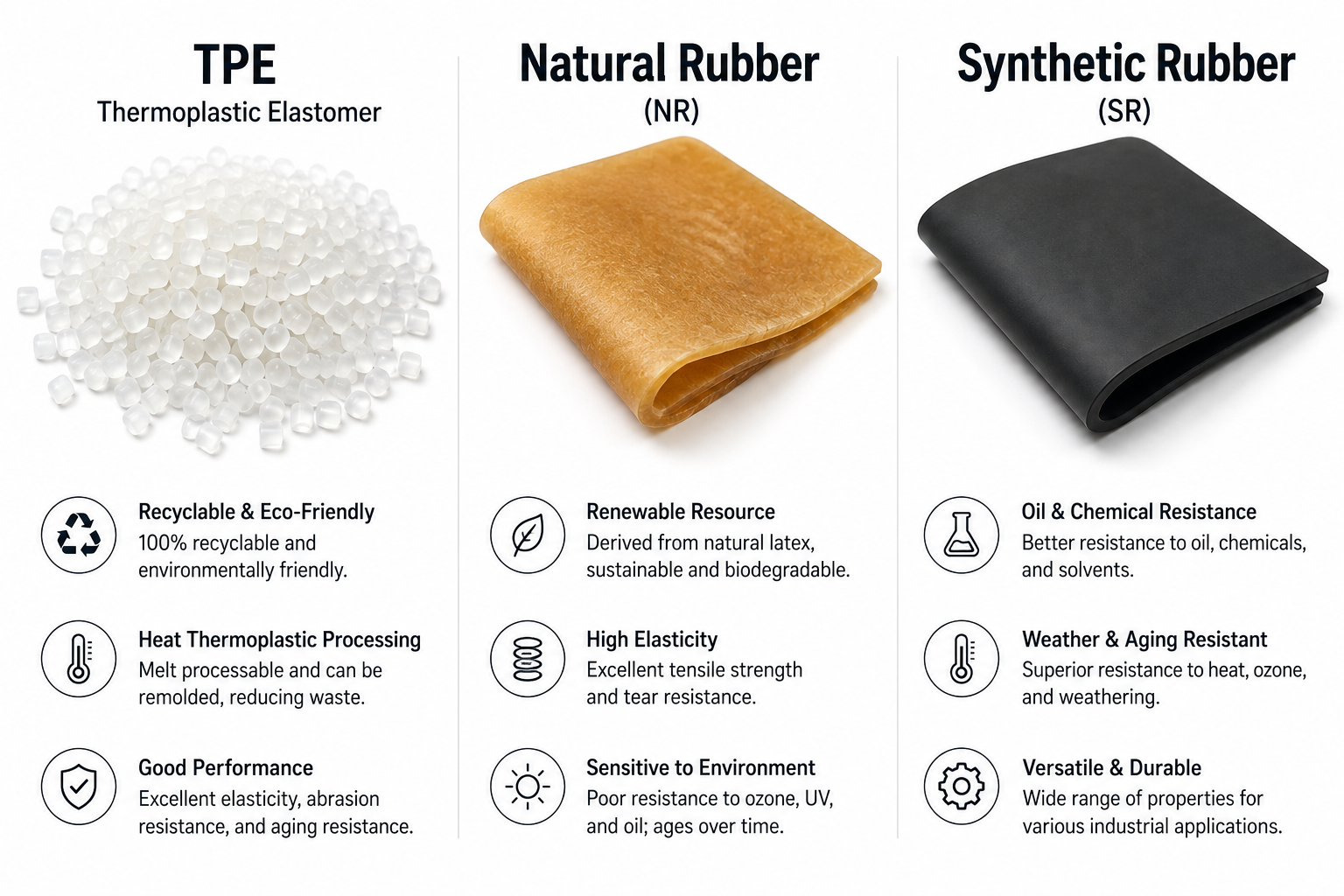
The Three Materials: A Fundamental Overview
The confusion between TPE, rubber, and latex exists because the fitness and industrial sectors use these terms loosely. A "rubber band" might be natural latex, synthetic rubber, or TPE — the label does not tell you. Understanding the actual material science behind each is critical for sourcing, safety, and performance.
Natural Rubber (= Natural Latex): Harvested as milky sap from Hevea brasiliensisrubber trees grown primarily in Thailand, Indonesia, and Malaysia (these three countries produce 70% of the world's natural rubber). The sap is collected by "tapping" — cutting the bark and letting the latex drip into cups. This raw latex is then coagulated, washed, and vulcanized (cross-linked with sulfur at 140-160°C) to create the elastic, durable material we call natural rubber. The vulcanization process, invented by Charles Goodyear in 1839, makes rubber elastic and heat-stable but also makes it a thermoset — once cross-linked, it cannot be melted or reshaped. This is why natural rubber is not recyclable.
Synthetic Rubber: A broad category of petroleum-derived polymers engineered to mimic natural rubber's elasticity. Common types include EPDM (ethylene propylene diene monomer), neoprene (polychloroprene), SBR (styrene-butadiene rubber), and NBR (nitrile butadiene rubber). Each type has different properties optimized for specific applications — EPDM for weather seals, neoprene for wetsuits, NBR for oil-resistant gaskets. Like natural rubber, synthetic rubbers are thermosets that require vulcanization and cannot be recycled. They are latex-free (no tree-derived proteins) but may contain other chemical sensitizers depending on formulation.
TPE (Thermoplastic Elastomer): A family of synthetic polymer compounds — most commonly SEBS-based (styrene-ethylene-butylene-styrene) — that combine the elasticity of vulcanized rubber with the processability of thermoplastics. The critical distinction: TPE achieves elasticity through physicalcross-links (hard and soft polymer blocks that self-assemble) rather than chemical cross-links (sulfur bonds). This means TPE can be melted, shaped, cooled, and re-melted without losing its properties — making it fully recyclable. TPE contains zero natural rubber, zero latex proteins, and zero vulcanization chemicals.
Three-Way Comparison Table
| Property | TPE (SEBS) | Natural Rubber (Latex) | Synthetic Rubber |
|---|---|---|---|
| Chemical Family | Thermoplastic elastomer (block copolymer) | Polyisoprene (cis-1,4) | Varies: EPDM, SBR, NBR, neoprene |
| Source | 100% synthetic (petroleum-derived) | Natural (rubber tree sap) | 100% synthetic (petroleum-derived) |
| Cross-linking | Physical (reversible) | Chemical / sulfur (permanent) | Chemical / sulfur (permanent) |
| Latex Allergens | None — zero Hev b proteins | Contains Hev b 1 through Hev b 13 | None (no tree proteins) |
| Allergy Risk | Extremely low | High (1-6% general; up to 17% healthcare) | Low to moderate (chemical sensitizers) |
| Elongation at Break | 500-800% | 600-900% | 300-600% (type-dependent) |
| Tensile Strength | 8-25 MPa | 20-35 MPa | 10-25 MPa (type-dependent) |
| Shore A Hardness Range | 30-90 (tunable) | 40-70 (narrower range) | 40-80 (type-dependent) |
| UV Resistance | Excellent (UV stabilizers added) | Poor (degrades in 6-12 months) | Good (EPDM excellent; NBR poor) |
| Temperature Range | -40 to 60 deg C | -20 to 40 deg C | -50 to 150 deg C (EPDM) |
| Odor | Odorless | Strong rubber smell | Moderate chemical odor |
| Recyclability | Fully recyclable (thermoplastic) | Not recyclable (thermoset) | Not recyclable (thermoset) |
| Biodegradability | No | Yes (1-5 years in soil) | No |
| Color Matching | Exact Pantone matching, unlimited colors | Limited — inconsistent dye absorption | Moderate — carbon black often required |
| Processing Method | Extrusion / injection molding (no vulcanization) | Vulcanization (sulfur + heat) | Vulcanization (sulfur + heat) |
| Cost (raw material) | Medium ($2.0-3.5/kg) | Low ($1.5-2.5/kg) | Low to medium ($1.8-4.0/kg) |
Chemical Structure: Why These Materials Behave Differently
The performance differences between TPE, natural rubber, and synthetic rubber all trace back to their molecular architecture. Understanding this helps you predict how each material will behave in your specific application.
Natural rubber (polyisoprene) is a long-chain polymer of isoprene units (C5H8) arranged in a cis-1,4 configuration. The "cis" arrangement means the polymer chains are kinked and coiled, which gives rubber its elasticity — when stretched, the chains uncoil; when released, they spring back. Vulcanization creates sulfur bridges between chains, locking in the elastic network permanently. This is also why rubber degrades under UV light — the sulfur cross-links are vulnerable to photo-oxidation, causing chain scission and surface cracking.
Synthetic rubbers replace the natural isoprene with synthetic monomers. EPDM uses ethylene and propylene (excellent weather resistance), SBR uses styrene and butadiene (good abrasion resistance for tires), and neoprene uses chloroprene (chemical resistance). All still require vulcanization and share the same thermoset limitation — once cross-linked, the material is permanently set.
TPE (SEBS type) achieves elasticity through a fundamentally different mechanism. SEBS is a triblock copolymer: hard polystyrene end-blocks (~30% by weight) connected by a soft ethylene-butylene mid-block (~70%). At room temperature, the polystyrene blocks aggregate into rigid "domains" that act as physical cross-links — anchoring the soft mid-block network in place. When heated above the glass transition temperature of polystyrene (~100°C), these domains soften and the material flows like a liquid, enabling processing and recycling. When cooled, the domains re-form and the elastic network is restored. This reversible cross-linking is the key advantage of TPE — it gives you rubber-like elasticity with plastic-like processability and recyclability.
Physical Performance: Elasticity, Strength, and Durability
For resistance band applications, three physical properties matter most: elongation at break (how far the material stretches before failing), tensile strength (how much force it can withstand), and fatigue resistance (how many stretch cycles before significant degradation).
Elongation at Break (ASTM D412)
Natural Rubber: 600-900%. The highest raw elongation of the three. This is latex's strongest advantage — per millimeter of thickness, it stretches furthest.
TPE (SEBS): 500-800%. Slightly lower than natural rubber at equal thickness, but easily compensated by increasing thickness 0.3-0.5mm. At TAICLET, our optimized 4.5mm TPE bands match the resistance range of standard 4.0mm latex bands.
Synthetic Rubber: 300-600%. Generally the lowest elongation. EPDM reaches 400-600%, SBR 300-500%, NBR 300-450%. Not ideal for high-stretch applications like resistance bands.
Tensile Strength (ASTM D412)
Natural Rubber: 20-35 MPa. Exceptionally high due to strain-induced crystallization — a unique property where the polymer chains align under stress, dramatically increasing strength. This is why natural rubber is still used in aircraft tires.
TPE (SEBS): 8-25 MPa. Lower than natural rubber, but more than adequate for resistance band forces (typically 5-80 lbs, well within the material's capacity at standard band dimensions).
Synthetic Rubber: 10-25 MPa. Varies widely by type. Neoprene and SBR are in the 15-25 MPa range; EPDM is lower at 10-15 MPa.
Fatigue Resistance (Cyclic Stretch Testing)
TAICLET TPE (4.5mm): Less than 5% resistance loss after 10,000+ cycles at 200% elongation. Band remains functional past 50,000 cycles with 12% loss. UV stabilizers prevent surface degradation.
Natural Rubber (4.0mm): 5% loss after 15,000 cycles. 15-20% loss by 25,000 cycles. Surface cracking visible by 10,000+ cycles. UV exposure accelerates degradation significantly.
EPDM Synthetic Rubber: Excellent fatigue resistance (comparable to TPE), but elongation is too low for resistance band use. Better suited for automotive seals and weatherstripping.
Allergy Risk: The Critical Safety Difference
Natural rubber contains a family of proteins designated Hev b 1 through Hev b 13 (named after the rubber tree Hevea brasiliensis). These proteins are the cause of latex allergy — a condition affecting an estimated 1-6% of the general population and up to 17% of healthcare workers with repeated latex exposure.
Latex allergy manifests in two forms. Type I (immediate hypersensitivity) is IgE-mediated and can cause urticaria (hives), angioedema (swelling), bronchospasm, and in severe cases, life-threatening anaphylaxis — typically within minutes of contact. Type IV (delayed hypersensitivity) is T-cell-mediated and causes allergic contact dermatitis — itching, redness, and blistering that develops 24-72 hours after exposure. Both types are triggered by the Hev b proteins in natural rubber.
TPE contains zero Hev b proteins because it is a completely synthetic material with no biological origin. There is no cross-reactivity between TPE and latex allergens. TPE is safe for individuals with both Type I and Type IV latex hypersensitivity. This is not a marketing claim — it is a fundamental chemical fact. TPE and natural rubber share no common molecular components.
Synthetic rubbers are also latex-free (no Hev b proteins), but they are not necessarily hypoallergenic. Vulcanization accelerators (thiurams, carbamates, mercaptobenzothiazole) used in synthetic rubber processing can cause Type IV contact dermatitis in sensitized individuals. TPE avoids this as well — it requires no vulcanization chemicals. For applications where allergy safety is non-negotiable (schools, hospitals, gyms, Amazon retail), TPE is the safest option across all three material families.
Environmental Impact: Recyclable vs Biodegradable vs Neither
Each material has a different environmental profile, and none is a clear "green" winner. The honest comparison requires looking at multiple dimensions.
TPE
- ✓ Fully recyclable (melt + re-extrude)
- ✓ Zero factory waste (regrind reused)
- ✓ No vulcanization (lower energy, no sulfur)
- ✗ Not biodegradable
- ✗ Petroleum-derived feedstock
Natural Rubber
- ✓ Biodegradable (1-5 years)
- ✓ Renewable resource (tree sap)
- ✓ Carbon-sequestering crop
- ✗ Not recyclable (thermoset)
- ✗ Deforestation risk in SE Asia
Synthetic Rubber
- ✓ Durable (reduces replacement frequency)
- ✗ Not recyclable (thermoset)
- ✗ Not biodegradable
- ✗ Petroleum-derived feedstock
- ✗ Vulcanization emissions
The lifecycle analysis favors TPE when you account for product longevity. A TPE resistance band lasting 50,000+ cycles replaces two latex bands over the same usage period, meaning less total material consumed and less waste generated — even though individual TPE bands are not biodegradable. At TAICLET, we recycle 100% of production waste and are working with polymer recycling partners to establish a post-consumer take-back program for used TPE bands.
Cost Comparison: Raw Material to Total Ownership
Cost analysis varies significantly depending on whether you look at raw material price, finished product cost, or total cost of ownership over the product's lifetime.
Cost Breakdown (per 1,000 finished resistance bands, FOB China)
TPE (SEBS-based, 4.5mm pull-up bands)
Raw material: $2.0-3.5/kg. Finished FOB: $3.80-4.20/set of 5. No vulcanization energy cost. Faster cycle time (extrusion vs. molding). Scrap is reground and reused (zero material waste).
Natural Rubber (4.0mm pull-up bands)
Raw material: $1.5-2.5/kg. Finished FOB: $3.30-3.70/set of 5. Vulcanization energy adds ~$0.10-0.15/set. Higher scrap rate (thermoset waste cannot be reprocessed).
Synthetic Rubber (EPDM seals, for reference)
Raw material: $1.8-4.0/kg (varies by type). Not typically used for resistance bands due to limited elongation. Dominant in automotive seals, HVAC gaskets, and roofing membranes.
The 10-15% unit cost premium for TPE over natural rubber is offset by three factors: (1) longer product life (fewer warranty replacements), (2) zero allergy liability exposure (critical for B2B sales to institutions), and (3) higher retail pricing power ("latex-free" commands 15-25% higher prices on Amazon and in D2C e-commerce).
At TAICLET, our in-house TPE pellet production reduces raw material cost by 8-12% compared to factories buying TPE on the open market. This vertical integration — from raw SEBS polymer to finished resistance band — keeps our pricing competitive with latex alternatives while delivering a premium product.See our wholesale pricing tiers.
Application Guide: Which Material for Which Use?
The "best" material depends entirely on your application. Here is a practical guide based on the properties we have compared:
TPE Is Best For:
- ✓ Resistance bands and fitness accessories
- ✓ Medical devices requiring latex-free certification
- ✓ Consumer products with skin contact (grips, handles, toys)
- ✓ Products needing exact color matching
- ✓ Brands targeting allergy-conscious consumers
- ✓ Applications requiring recyclable materials
Natural Rubber Is Best For:
- ✓ Ultra-high-stretch applications (surgical tubing, balloons)
- ✓ High-stress dynamic applications (tires, engine mounts)
- ✓ Applications where biodegradability is required
- ✓ Budget-driven procurement (lowest raw material cost)
Synthetic Rubber Is Best For:
- ✓ Automotive seals and gaskets (EPDM)
- ✓ Wetsuits and diving gear (neoprene)
- ✓ Oil-resistant industrial seals (NBR/nitrile)
- ✓ High-temperature applications (silicone rubber to 230°C)
- ✓ Tires and conveyor belts (SBR)
TAICLET's Advantage
As a vertically integrated manufacturer, TAICLET produces its own TPE pellets from raw SEBS polymer. This gives us precise control over material formulation — we can tune hardness (Shore A 30-90), elongation, UV resistance, and color for each customer's specific application. No middleman, no generic compound, no guesswork.Learn about our manufacturing process.
The Verdict: TPE Is the Modern Alternative to Rubber
Natural rubber and synthetic rubber have served industry well for over 180 years. But for a growing list of applications — especially those involving skin contact, allergy safety, recyclability, and brand differentiation — TPE is the superior modern alternative.
The key takeaways from this comparison:
- Natural rubber IS latex — they are the same material. Any product made from natural rubber contains latex allergens.
- TPE is neither rubber nor latex — it is a completely different polymer family with zero allergy risk.
- Synthetic rubber is latex-free but not hypoallergenic — vulcanization chemicals can cause contact dermatitis.
- TPE is the only recyclable option — both natural and synthetic rubbers are thermosets that cannot be reprocessed.
- Natural rubber has the highest raw elasticity — but TPE compensates with slightly thicker formulations, and wins on durability, UV resistance, and processability.
For resistance bands specifically, TPE has become the industry standard for wholesale buyers, Amazon brands, and institutional purchasers. The allergy safety, longer lifespan, and "latex-free" marketing premium make the business case overwhelming. Read our detailed comparison ofTPE vs latex specifically for resistance bands.
About the Author
This guide was written by the TAICLET technical team. We are a vertically integrated TPE manufacturer that produces its own SEBS-based pellets in Danyang, Jiangsu Province, China. Our material science expertise spans 20+ years of TPE formulation, compounding, and product development.Learn more about TAICLET.
How TAICLET Produces TPE Resistance Bands
As a vertically integrated manufacturer, TAICLET controls every step from raw SEBS polymer to finished resistance band. Our in-house compounding process works as follows:
- 1. Pellet compounding: Raw SEBS polymer, mineral oil (for softness), and UV stabilizers are blended in twin-screw extruders at 180-210°C. The formulation is proprietary — each product line (pull-up bands, mini loops, chair bands) uses a different hardness/elongation profile.
- 2. Sheet extrusion: Compounded pellets are fed into flat-die extrusion lines that produce continuous TPE sheets at precisely controlled thickness (1.5-6.0 mm, ±0.1 mm tolerance).
- 3. Cutting and finishing: Sheets are die-cut to final dimensions. Pull-up bands are welded into continuous loops. Mini loops are precision-cut with rounded edges to prevent skin irritation.
- 4. Quality control: Every batch undergoes tensile testing (ASTM D412), elongation verification, and visual inspection. Defective material is reground and fed back into the compounding line — zero waste.
- 5. Custom finishing: Logo silk-screening, Pantone color matching, and packaging are done in-house. No outsourcing, no middlemen.
This vertical integration gives us two key advantages: material consistency (every band uses the same formulation, batch after batch) and cost efficiency (we save 8-12% on raw material vs. factories that buy pre-made TPE sheets). For OEM customers, we can also develop exclusive formulations — your material, your bands, nobody else's.See our full manufacturing process guide.
Related Resources
- TPE vs Latex Resistance Bands: Which Is Better?— Head-to-head comparison with factory test data on elasticity, durability, and cost.
- Natural Rubber vs Latex: Are They the Same Thing?— Definitive answer on the rubber-latex relationship and why it matters for allergies.
- Latex Free Rubber Bands & Non-Latex Rubber Bands Guide— Who needs them, how to verify, and how to source at scale.
- Pull-Up Bands (TPE)— 8 resistance levels, 5 lbs to 175 lbs, custom color and logo available.
- Mini Loop Bands (TPE)— 7 colors, ideal for Pilates, physical therapy, and rehabilitation.
- Get Custom Bands with Your Logo — OEM/ODM from 200 sets, Pantone matching, retail packaging.
- Wholesale Pricing & MOQ — Factory-direct tiered pricing for all band types.
- Request a Free Quote — Samples in 3-5 days, 12-hour response time.