
Resistance Bands for Postpartum Recovery: Pelvic Floor, Diastasis Recti & Glute Activation
Published 2026-09-23 · 13 min read · Rehabilitation Guide
Quick answer: start with an X-Light band (5-10 lbs) placed above the knee for glute bridges and clamshells, not because you're weak, but because early postpartum training is about motor control, not load. A band does not close diastasis recti by itself — that takes supervised transverse abdominis work — but banded glute and hip activation reduces the compensatory strain on your midline while that healing happens. Get OB or pelvic floor PT clearance before starting, generally around the 6-week checkup for uncomplicated vaginal deliveries, later after a cesarean or any pelvic floor symptoms.
We manufacture the TPE mini loop bands that a fair number of postpartum fitness programs and pelvic floor clinics already use, and we kept noticing the same gap when we looked at what's published on this topic: the fitness-brand content is warm and motivational but avoids giving an actual tension number, and the clinical content assumes you already have a physical therapist walking you through it. Neither answers the question a lot of buyers ask us directly — which band, starting where, and why.
This guide is written for two audiences at once: postpartum individuals and trainers choosing a band, and clinics or studio owners sourcing sets in bulk. If you're the latter, the sourcing section and wholesale numbers are near the end. If you're the former, please read the caveats section before you read the exercises — this is general product and exercise-selection information, not a substitute for an individual clinical assessment.
Why a Band, and Why Not Just Bodyweight or a Weight Rack
Early postpartum training has a narrow target: reactivate muscles that switched off during pregnancy (mainly the deep core, glute medius, and pelvic floor) without loading the trunk in a way that increases intra-abdominal pressure. A loop band solves a problem bodyweight can't: it gives the glute something to push against in a bridge or clamshell where bodyweight alone provides almost no resistance, while staying light enough that form doesn't break down under load. A dumbbell or a barbell solves the opposite problem — too much load, too early, encourages compensation through the low back and abdominal wall exactly when you're trying to protect it.
The other reason bands specifically, and not resistance tubing with handles: a loop band keeps both hands free to palpate, cue, or support your weight, which matters when you're relearning a movement pattern rather than lifting for output. This is also why physical therapists default to loop bands for this population rather than the tube-and-handle sets we cover in our resistance tube kit guide.
The Clearance Timeline: What Comes Before Band Work
This is general information reflecting common postpartum care timelines, not a personal medical recommendation. Every recovery is different, and cesarean delivery, significant tearing, or any pelvic floor symptoms should push all of this later and route through an individual PT assessment rather than a calendar.
| Timeframe | Typical focus | Band work? |
|---|---|---|
| Days 1-14 | Diaphragmatic breathing, gentle pelvic floor awareness, walking as tolerated | No |
| Weeks 2-6 | Continued breath work, posture, gradual walking distance, transverse abdominis engagement cues | Usually not yet |
| Week 6 checkup | OB/midwife clearance for exercise (later after cesarean or complications) | Decision point |
| Weeks 6-12 | X-Light band glute and hip activation, continued core reconnection | Yes, X-Light |
| 3+ months | Progressive strength work if activation is solid and no symptoms present | Light to Medium, gradually |
The single most common mistake we hear from postpartum program coordinators isn't tension — it's timeline. Clients who trained heavily pre-pregnancy tend to skip the activation phase entirely and jump back to the resistance level they used a year earlier. A band with a visibly different color for "postpartum starting tension" versus your general fitness set is a small design choice that prevents a lot of that.
Running a postpartum program? We can pre-select and label a 3-band starting subset (X-Light/Light/Medium) so clients don't reach for the wrong tension on day one. Ask about custom kitting →
How a Band Actually Helps the Pelvic Floor
A resistance band does not train the pelvic floor directly the way a Kegel, a biofeedback device, or manual PT work does. What it does is train the muscles that act as synergists to the pelvic floor, mainly the glute medius and deep hip rotators. When those muscles fire correctly during a bridge, clamshell, or standing hip abduction, the pelvic floor tends to co-contract as part of a coordinated stabilization pattern, rather than being left to stabilize the pelvis on its own while the hips stay passive. That's the mechanism behind why a mini loop band positioned just above the knee is such a standard tool in postpartum PT programs: the band gives the glute medius something to work against, and the pelvic floor benefits as a downstream effect.
Practically, this means band placement matters more than band brand. Above the knee for glute medius bias (bridges, clamshells, lateral walks); around the ankles shifts more work to the glute maximus and is generally introduced later, once glute medius activation is reliable.
Diastasis Recti: What the Band Can and Can't Do
We want to be direct about this because it's the claim most postpartum product marketing gets wrong. Diastasis recti — separation of the rectus abdominis at the linea alba, which is a normal and expected part of most pregnancies — is not closed by a resistance band. It responds to a progression of deep core and transverse abdominis activation, coordinated with breath, generally assessed and guided by a pelvic floor or postpartum physical therapist who can measure the inter-recti distance and check the tension quality of the connective tissue, not just the gap width.
Where a band fits in is adjacent, not central: banded glute and hip work reduces the degree to which your abdominal wall has to compensate for weak hip stability during daily movement (getting up from the floor, carrying a car seat, standing from a chair while holding a baby). Less compensatory strain on the midline supports the healing environment, but it is support, not treatment. Exercises that spike intra-abdominal pressure — crunches, sit-ups, or straining against a band that's too heavy — can actively work against closure, which is exactly why we don't include ab-crunch movements in the sequence below.
Choosing the Right Tension
We manufacture our mini loop bands in a 5-color, 5-level system: Green, Blue, Yellow, Red and Black, spanning X-Light to X-Heavy across a 5-40 lb range, 600mm circumference, 0.4-1.2mm thickness, 100% latex-free TPE. Postpartum programs almost never use the top two levels. Here's how we'd map our own color system to this use case, and it's worth checking against whatever chart came with the bands you already own, since color codes are not standardized across brands.
| Level | Resistance | Use in this progression | When |
|---|---|---|---|
| X-Light | 5-10 lbs | Glute bridge, clamshell, first standing abduction reps | Start here, weeks 6-12 |
| Light | 10-15 lbs | Same movements, higher rep control, added lateral walks | Once X-Light feels easy, 2 sessions in a row |
| Medium | 15-20 lbs | Progressive glute/hip strength once activation is solid | 3+ months, no symptoms |
| Heavy | 20-30 lbs | General fitness, not this progression | — |
| X-Heavy | 30-40 lbs | General fitness, not this progression | — |
The tension test that matters more than any chart: at your working level, you should be able to complete 12-15 reps feeling the target muscle (glute, hip) doing the work, with no bearing-down sensation, no pelvic heaviness, and no leaking. Any of those three symptoms during or after a set means the tension or the movement is currently too much, regardless of what color the band is.
A 4-Move Starting Sequence
General information for after clearance, not a substitute for individualized guidance from your provider or a pelvic floor physical therapist. Stop and check in with a clinician if you notice bearing-down pressure, pelvic heaviness, or leaking with any of these.
- Banded glute bridge — band above the knees, feet hip-width, lie on your back. Exhale as you lift the hips, keeping tension on the band so the knees don't cave in. 2 sets of 10-12, X-Light.
- Clamshell — band above the knees, side-lying, knees bent. Exhale as you rotate the top knee open, keeping hips stacked. 2 sets of 10-12 per side, X-Light.
- Standing hip abduction — band above the ankles or knees, holding a wall or chair for balance. Lift one leg out to the side without leaning the torso. 2 sets of 10 per side, X-Light.
- Standing band pull-apart with breath — light flat band or tube held at chest height, pull apart while exhaling fully, focusing on ribcage-to-pelvis connection rather than arm effort. 2 sets of 10.
Progress volume (more reps, more sets) before you progress tension. That order matters more here than in general fitness training, where progressing weight quickly is often the goal.
Material Choice: Why Latex-Free Matters More in This Population
We cover the general case for latex-free training equipment in our latex-free rubber bands guide, but two things are specific to postpartum use. First, postpartum skin is frequently more reactive due to hormonal shifts, and a band worn directly against skin for banded glute work is a more common irritation trigger in this window than in general fitness use. Second, several postpartum and breastfeeding clients report new sensitivity to the tackier odor of natural rubber latex, consistent with hormonally heightened smell sensitivity in this period. TPE mini loop bands are 100% latex-free and odorless; fabric-covered hip bands add a comfort layer between band and skin and don't roll the way a thin loop can if positioned slightly off.
Sourcing for Postpartum Programs, Clinics & Studios
If you run a postpartum fitness program, a pelvic floor PT practice, or a doula or postpartum-doula service and are considering bands as a client takeaway or in-session tool, three sourcing decisions come up repeatedly with our buyers:
| Decision | What most postpartum buyers choose |
|---|---|
| Band type | TPE mini loop (precise tension) or fabric hip band (comfort/grip) — see our mini loop bands |
| Set size | 3-band subset (X-Light/Light/Medium) rather than the full 5-band fitness range |
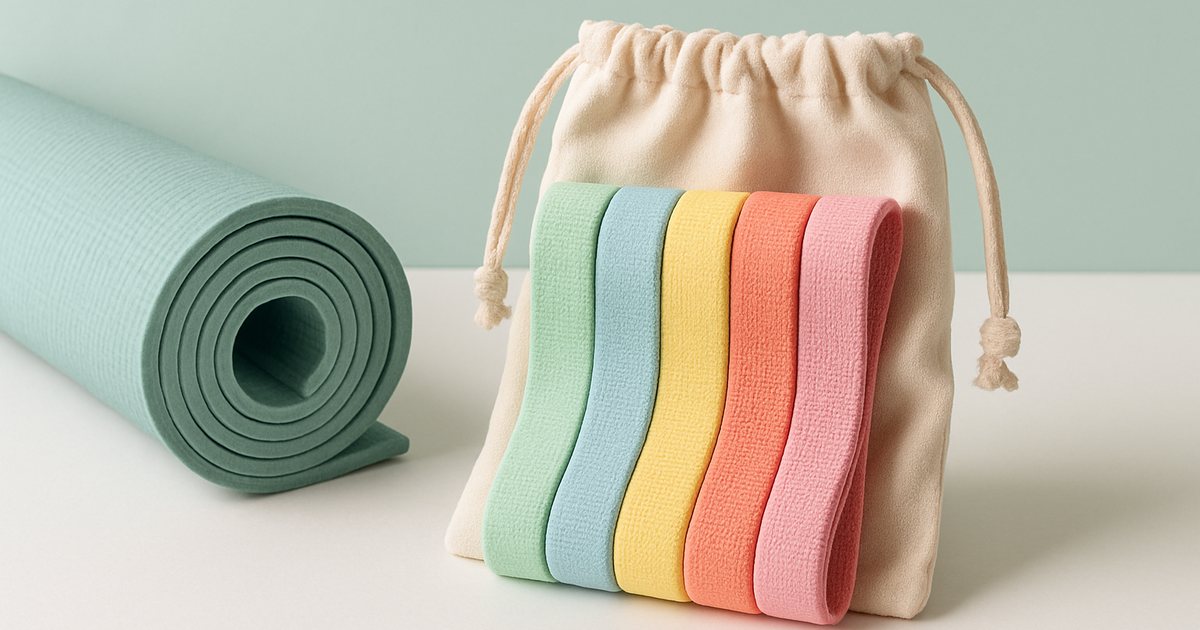
| Packaging | Soft drawstring pouch with a printed care/progression card, not a retail box |
| Branding | Private label with clinic/studio logo at OEM MOQ 200 sets; unbranded from 1,000 sets |
We're a TPE-only manufacturer in Danyang, Jiangsu — no natural rubber latex anywhere in our production — which is one reason clinics come to us specifically for this use case rather than a general fitness supplier. Lead time on a private-label postpartum set with custom colors and a printed pouch typically runs 20-25 days after sample approval; see our sample approval process for how that stage works. If you need CPSIA/REACH documentation for a retail or insurance-reimbursable channel, that's covered in our compliance and certificates guide.
Where This Guide Has Limits
Two honest limits, because a guide on a health-adjacent topic that claims none isn't worth trusting. First, this article gives general, common-practice timelines and exercise selection; it is not a clinical assessment, and diastasis recti gap width, pelvic floor pressure symptoms, and cesarean recovery all vary enough between individuals that a calendar-based guide can only be a starting point, not a replacement for a pelvic floor PT evaluation. Second, the claim that hip and glute activation supports pelvic floor function reflects a widely used principle in postpartum physical therapy practice, not a single specific clinical trial we're citing by name here — we'd rather say that plainly than attach a citation that overstates the evidence.
Frequently Asked Questions
What resistance band tension is safe for postpartum exercise?
Start at X-Light (5-10 lbs on a standard mini loop band), regardless of pre-pregnancy strength. The early goal is activation and motor control, not load. Move to Light (10-15 lbs) once X-Light feels easy for 12-15 controlled reps across two consecutive sessions.
Can resistance bands fix diastasis recti?
No. Diastasis recti responds to a supervised progression of transverse abdominis activation and breath coordination, ideally assessed by a pelvic floor or postpartum PT. A band supports that process indirectly through hip and glute work; it is not a standalone treatment, and moves that spike intra-abdominal pressure can work against closure.
How does a resistance band help the pelvic floor?
Indirectly, through the hip. The glutes and deep hip rotators are synergists of the pelvic floor, so when a band placed above the knee drives correct glute medius firing in a bridge or clamshell, the pelvic floor tends to co-contract as part of that stabilization pattern.
When can I start using resistance bands after giving birth?
General guidance points to gentle breathing and pelvic floor awareness in the first weeks, with structured band-based glute and hip work introduced around the 6-week checkup and only after OB or midwife clearance. Cesarean delivery, tearing, or pelvic floor symptoms push this later and need an individual PT assessment.
Are fabric or TPE bands better than latex for postpartum use?
Yes, for this population specifically. Postpartum skin is often more reactive, making direct-skin latex contact a more common irritant than in general fitness use, and some postpartum or breastfeeding women report new sensitivity to latex's stronger odor. TPE mini loop bands are 100% latex-free and odorless.
What's the difference between a mini loop band and a fabric hip band for this?
A TPE mini loop is thin and precise for feeling exact tension; a fabric hip band is wider and grips without rolling, which some find more comfortable on postpartum skin. No strength difference at the same rated resistance — it's a comfort and grip choice.
Can I order postpartum recovery band sets with our clinic's own branding?
Yes. Private-label mini loop sets with custom colors, a printed logo pouch, and an insert card at OEM MOQ 200 sets, or unbranded wholesale from 1,000 sets, FOB Ningbo. Most postpartum buyers choose a 3-band X-Light/Light/Medium subset rather than the full 5-band range.
Related Guides
- Resistance bands for physical therapy: the complete clinic purchasing guide
- Resistance band glute exercises: 12 best moves for stronger glutes — general fitness progression, once cleared past this one
- Latex free rubber bands guide
- Resistance band color code chart — why color systems differ by brand
- Resistance bands for occupational therapy: a clinical guide
- Resistance band samples: how to order, test and approve before bulk
Talk to the Factory
TAICLET is a TPE-only manufacturer in Danyang, Jiangsu — six extrusion lines, 30 million+ bands a year, no natural rubber latex in any product. We supply postpartum fitness programs, pelvic floor clinics, and doula practices with pre-kitted, custom-labeled starting sets.
Browse mini loop bands, or send us your requirements. OEM from 200 sets, wholesale from 1,000 sets, FOB Ningbo.
Building a postpartum starter kit? Tell us your target tension range and set size and we'll quote a pre-kitted, labeled 3-band set with samples in 3-5 days on stock colors. Request a quote →
Sources
- General postpartum physical activity and pelvic floor recovery timelines as commonly described in postpartum physical therapy practice
- TAICLET internal product specifications, mini loop band 5-color tension system (5-40 lbs, 600mm x 50mm, 0.4-1.2mm, latex-free TPE)
- TAICLET latex allergy and material safety data, see latex-free rubber bands guide