
TPE Rubber (TPE-S): What It Is, Properties & Why It's Replacing Latex in Fitness Bands
Published 2026-09-06 · 14 min read · Material Science
TPE rubber — specifically TPE-S (Thermoplastic Elastomer – Styrenic) — has become the dominant material in fitness resistance bands, replacing natural latex in over 70% of new product launches since 2022. If you have searched for "TPE rubber" or "what is TPE-S," you are likely evaluating this material for a product line, sourcing decision, or formulation question. This guide explains TPE-S from the manufacturer's perspective: what it is chemically, its measurable properties, how it compares to latex and other TPE families, and why TAICLET compounds its own SEBS-based TPE pellets in-house rather than buying commodity compounds.
What Is TPE-S? The Chemistry in Plain Language
TPE-S stands for Thermoplastic Elastomer – Styrenic. It is one of six recognized TPE families (per ISO 18064), and the largest by global production volume. TPE-S materials are block copolymers — long polymer chains made up of alternating "hard" polystyrene blocks and "soft" elastomeric blocks.
The hard polystyrene blocks act as physical cross-links, giving the material its shape, tensile strength, and resistance to permanent deformation. The soft blocks provide rubber-like elasticity — the ability to stretch to 500-700% of original length and snap back. Unlike vulcanized natural rubber, these cross-links are physical (not chemical), meaning they can be broken by heat and reformed — making TPE-S fully recyclable.
The Two Grades That Matter: SEBS vs SBS
Within the TPE-S family, two grades dominate the market. The difference between them is a single chemical step — hydrogenation — but it dramatically affects performance and lifespan:
| Property | SEBS (Premium) | SBS (Standard) |
|---|---|---|
| Full name | Styrene-Ethylene-Butylene-Styrene | Styrene-Butadiene-Styrene |
| Hydrogenated? | Yes — saturated backbone | No — unsaturated double bonds remain |
| UV resistance | Excellent (no UV-sensitive bonds) | Moderate (degrades in sunlight) |
| Ozone resistance | Excellent | Moderate (ozone attacks double bonds) |
| Shelf life | 3-5 years | 1-3 years |
| Temperature range | -60°C to +120°C | -40°C to +70°C |
| Odor | Odorless | Slight rubber smell possible |
| FDA food contact | Yes (21 CFR 177.2600) | Not typically compliant |
| Raw material cost/ton | $2,800-3,500 | $1,800-2,400 |
| Recommended for | Resistance bands, yoga mats, medical | Shoe soles, adhesives, low-cost goods |
Manufacturer's recommendation: For any skin-contact fitness product — resistance bands, exercise tubes, yoga straps, therapy bands — SEBS is the only correct specification. The 30-40% higher raw material cost is justified by dramatically better aging performance, zero odor, and FDA compliance. At TAICLET, 100% of our resistance band production uses SEBS-based compounds.
TPE-S Physical Properties: The Numbers That Matter
When evaluating TPE-S for a fitness product, these are the measurable properties that determine real-world performance. All values below are from TAICLET's in-house testing on our SEBS-based resistance band compound:
| Property | Value | Test Standard |
|---|---|---|
| Shore A hardness range | 25-65 (adjustable by formulation) | ASTM D2240 / ISO 868 |
| Tensile strength | 8-25 MPa (varies with Shore A) | ASTM D412 / ISO 37 |
| Elongation at break | 500-700% | ASTM D412 / ISO 37 |
| Elastic recovery (200% stretch) | 92-97% | Internal method |
| Tear strength | 25-55 kN/m | ASTM D624 / ISO 34-1 |
| Density | 0.88-0.95 g/cm³ | ASTM D792 |
| Compression set (70°C, 22 hr) | 15-35% | ASTM D395 |
| Melt flow index | 2-15 g/10min (190°C, 2.16 kg) | ASTM D1238 |
| Service temperature | -60°C to +120°C | — |
| Fatigue life (200% elongation) | 10,000+ cycles | Internal cyclic testing |
How Shore A Hardness Maps to Resistance Levels
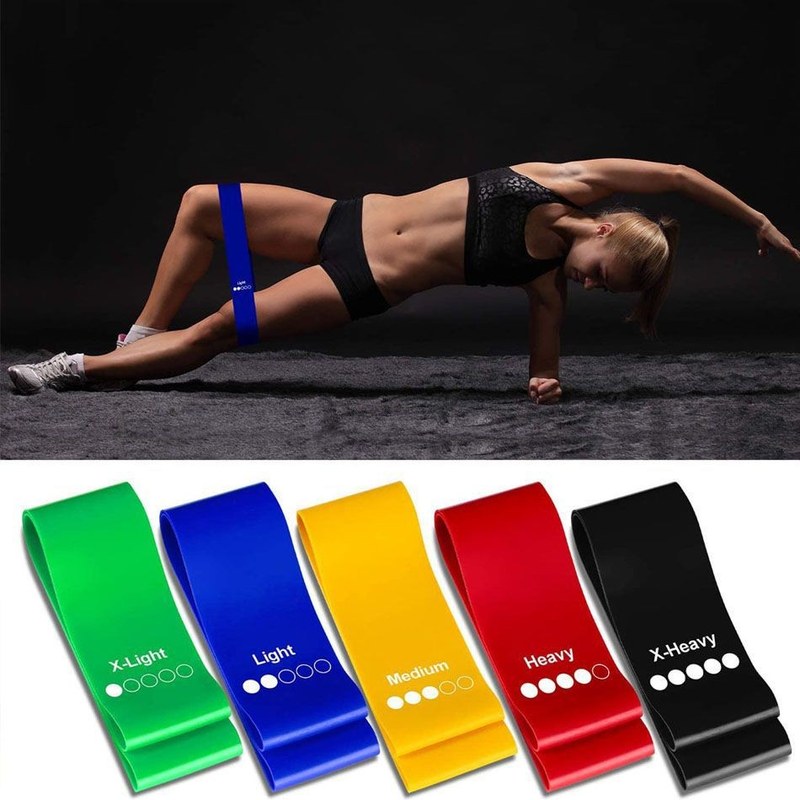
Shore A hardness is the single most important specification for resistance bands — it directly determines the force required to stretch the band. Here is how we map Shore A to color-coded resistance sets:
| Resistance Level | Shore A Range | Typical Color | Best Application |
|---|---|---|---|
| X-Light | 25-30 | Yellow / Peach | Rehabilitation, seniors, warm-up |
| Light | 30-35 | Green / Pink | Beginners, physical therapy, yoga |
| Medium | 35-45 | Blue / Red | General fitness, Pilates, toning |
| Heavy | 45-55 | Black / Purple | Strength training, CrossFit |
| X-Heavy | 55-65 | Silver / Gold | Powerlifting, pull-up assist |
At TAICLET, we compound custom Shore A values in 5-point increments, allowing brands to specify exact resistance levels for each color in their set. This precision is only possible because we compound our own SEBS pellets in-house — we control the polymer-to-filler ratio, plasticizer content, and processing oil percentage at every step.
TPE-S vs Natural Latex: The Complete Comparison
The shift from latex to TPE-S in the fitness industry is not a fad — it is driven by measurable advantages in safety, consistency, and supply chain stability:
| Factor | TPE-S (SEBS) | Natural Latex |
|---|---|---|
| Allergen risk | Zero — 100% synthetic | High — contains Hev b proteins |
| Latex allergy prevalence | Not applicable | 1-6% general population, up to 17% healthcare workers (ALAA) |
| Elongation at break | 500-700% | 600-900% |
| Elastic recovery | 92-97% | 95-99% |
| Tensile strength | 8-25 MPa | 15-35 MPa |
| UV/ozone resistance | Excellent (SEBS) | Poor — cracks and degrades |
| Shelf life | 3-5 years | 1-3 years |
| Odor | Odorless | Distinct rubber smell |
| Recyclability | Yes — thermoplastic | No — thermoset (vulcanized) |
| Batch consistency | Excellent (synthetic = repeatable) | Variable (natural agricultural product) |
| Color options | Any Pantone color, vivid | Limited, muted tones |
| Price per kg | $2.80-3.50 (SEBS compound) | $1.80-2.80 (natural rubber) |
Where latex still wins: Raw tensile strength and ultimate elongation. Natural latex can stretch further and handle higher peak forces. This is why latex remains the choice for heavy-duty pull-up assist bands rated above 100 lbs resistance, where maximum tensile strength matters more than allergen safety or shelf life.
Where TPE-S wins everything else: Safety (no allergens), consistency (synthetic = identical batch to batch), aging (no UV/ozone cracking), recycling, color vibrancy, and odor. For the 90%+ of resistance band applications that do not require extreme tensile strength, TPE-S is the superior material.
TPE-S vs Other TPE Families: TPE-O, TPU, TPE-V
Buyers sometimes confuse TPE-S with other thermoplastic elastomer families. Here is how they compare for fitness applications specifically:
| TPE Family | Elongation | Recovery | Best Application | Suitable for Bands? |
|---|---|---|---|---|
| TPE-S (SEBS) | 500-700% | 92-97% | Resistance bands, yoga mats | Yes — ideal |
| TPE-O (TPO) | 200-400% | 70-85% | Automotive bumpers, packaging | No — insufficient elasticity |
| TPE-U (TPU) | 400-600% | 80-92% | Phone cases, cable covers, tubes | Marginal — lower recovery |
| TPE-V (TPV) | 200-500% | 85-95% | Automotive seals, weatherstrip | No — too stiff |
| TPE-A (PEBA) | 300-500% | 85-95% | Ski boots, medical catheter | No — too expensive |
The key differentiator is elastic recovery — the percentage of its original shape a material returns to after being stretched. A resistance band stretched 200% that only recovers 85% will feel "dead" and inconsistent after a few uses. SEBS's 92-97% recovery rate means the band maintains consistent resistance force across thousands of stretch cycles.
Why TPE-S Is Replacing Latex: Market Drivers
1. Institutional Latex Bans
Hospitals, physical therapy clinics, schools, and corporate wellness programs are systematically eliminating latex from their facilities. The trigger: latex allergy lawsuits. A single anaphylaxis event from a latex exercise band in a PT clinic can generate $500,000+ in liability. TPE-S eliminates this risk entirely, and institutional buyers increasingly require latex-free certification as a procurement condition.
2. Amazon and Retail Compliance
Amazon requires clear allergen labeling for latex products. Products marketed as "latex-free" receive higher search rankings in health-conscious categories. Major retailers (Target, Walmart, Decathlon) are increasing shelf space for latex-free fitness accessories in response to consumer demand.
3. Supply Chain Stability
Natural rubber latex prices fluctuate 30-50% year-to-year based on weather, disease (South American Leaf Blight remains a threat), and geopolitical factors affecting Southeast Asian rubber plantations. TPE-S pricing, derived from petroleum feedstocks with multiple global suppliers, is significantly more stable — typically varying 10-15% annually. For brands planning production 6-12 months ahead, TPE-S offers far more predictable costing.
4. Sustainability Messaging
TPE-S's recyclability is a genuine environmental advantage over vulcanized latex, which cannot be recycled. Brands positioning around sustainability — particularly in European markets where circular economy regulations are tightening — gain a real story: "Our bands are 100% recyclable thermoplastic, not single-use thermoset rubber."
Manufacturing Process: How TPE-S Resistance Bands Are Made
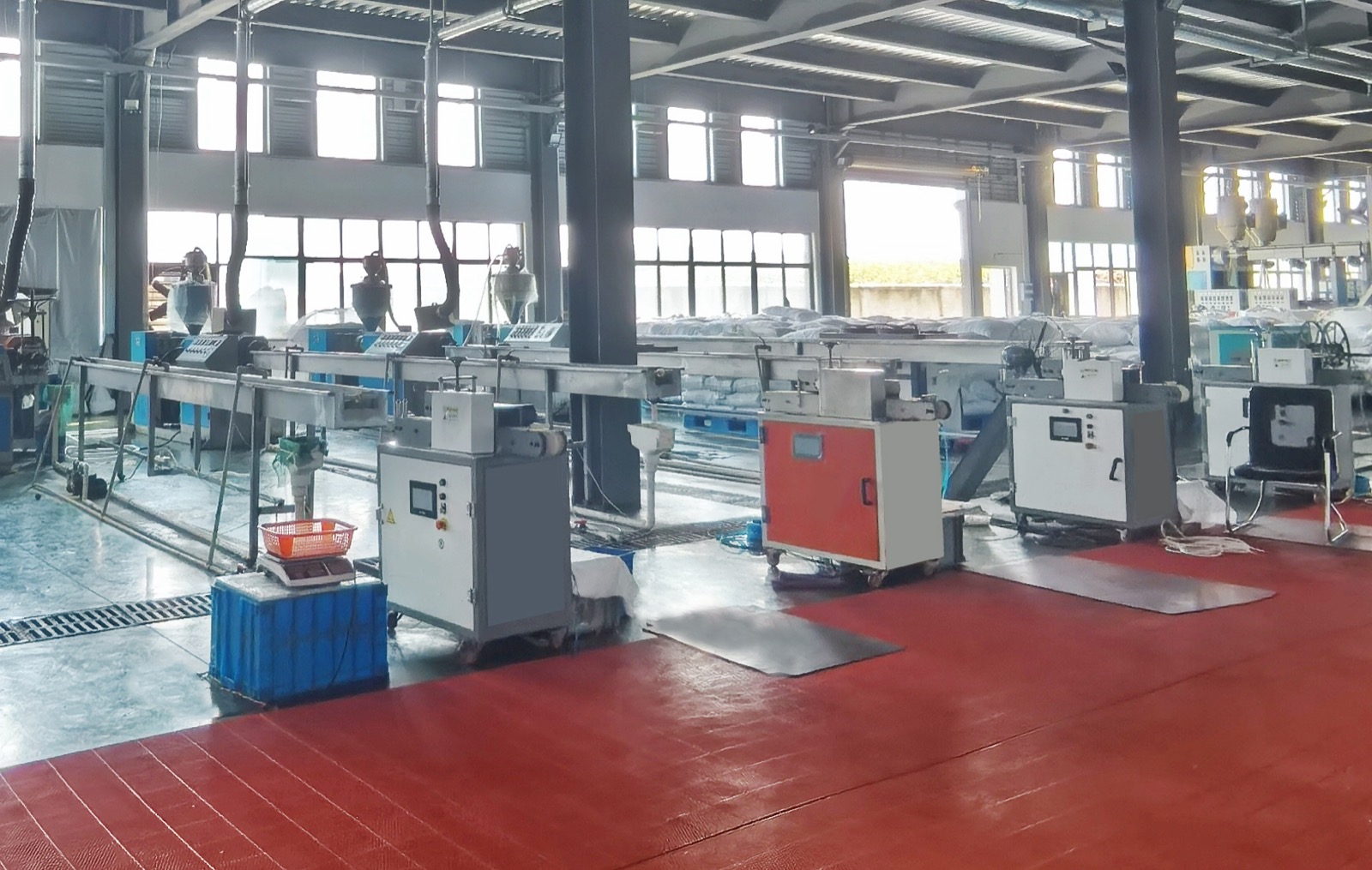
Understanding the manufacturing process explains why in-house compounding produces better bands than buying pre-made TPE compounds:
- Compounding: SEBS base polymer is blended with processing oil (paraffinic), fillers (calcium carbonate or talc), colorants (masterbatch), and UV stabilizers. The ratio determines Shore A hardness, tensile strength, and elongation. At TAICLET, this step happens in our own facility — not outsourced.
- Pelletizing: The compound is extruded into pellets for consistent feeding into the production line.
- Extrusion: Pellets are melted at 170-200°C and extruded through a flat die to form continuous sheet or strip. Temperature control is critical — ±2°C variation affects Shore A by up to 3 points.
- Calibration: The extruded strip passes through a calibration station that sets final thickness (±0.2mm tolerance) and width.
- Cooling: Controlled air cooling sets the material's crystalline structure, which affects elastic recovery performance.
- Cutting and finishing: Bands are cut to length, edges are heat-sealed (no sharp edges), and logo is printed or embossed.
- Quality testing: Random samples from each batch are tested for Shore A hardness, tensile strength, elongation at break, and elastic recovery.
Read our detailed factory process guide for a full walkthrough with photos from our production line.
How to Specify TPE-S When Sourcing Resistance Bands
When contacting manufacturers for quotes, specify these parameters to get accurate pricing and avoid material substitution:
- Base polymer: SEBS (not SBS) — this is the most important specification
- Shore A hardness: Specify per SKU (e.g., Yellow = Shore A 28, Green = Shore A 33, Blue = Shore A 42)
- Dimensions: Length x width x thickness in mm (e.g., 600mm x 50mm x 0.65mm)
- Compliance: FDA 21 CFR 177.2600, REACH, RoHS, Prop 65 (California)
- Testing: Request tensile test certificate (ASTM D412) and Shore A hardness report per batch
- Color: Provide Pantone codes for each resistance level
Warning: Some manufacturers quote "TPE" without specifying the sub-family. "TPE" could be TPE-O (cheap, insufficient elasticity) labeled as "TPE resistance bands." Always demand confirmation that the compound is SEBS-based TPE-S, and request a material data sheet showing elongation at break above 500%. If the manufacturer cannot provide this, they are likely using TPE-O or a low-grade SBS blend.
Pricing: What TPE-S Resistance Bands Actually Cost
Transparent pricing helps you evaluate quotes from multiple manufacturers:
| Product | FOB Price Range | MOQ |
|---|---|---|
| Mini loop band (single) | $0.25-0.60 | 3,000 pcs |
| Mini loop set (5 bands + bag) | $1.80-3.50 | 1,000 sets |
| Long resistance band (1.5m) | $0.80-1.80 | 2,000 pcs |
| Pull-up band (41" loop) | $1.20-4.50 | 1,000 pcs |
| Resistance tube with handles | $1.50-3.00 | 1,000 pcs |
| Custom logo printing | +$0.05-0.15/pc | 3,000 pcs |
| Custom packaging | +$0.30-1.00/set | 1,000 sets |
These are FOB China prices for SEBS-based TPE-S bands. If a quote comes in significantly lower, ask about the material — it may be SBS or TPE-O substitution.
Need TPE-S Resistance Bands for Your Brand?
TAICLET manufactures SEBS-based TPE-S resistance bands with in-house compounding, custom Shore A formulation (5-point increments), any Pantone color, and custom logo/packaging. OEM clients in 45+ countries. MOQ from 1,000 sets.
Related Guides
- TPE Rubber: What It Is & Why Fitness Brands Choose It — Broader overview of TPE in the fitness industry.
- TPE vs Latex Resistance Bands — Side-by-side comparison focused on end-user experience.
- Fabric vs TPE vs Latex Bands — Three-way material comparison for brand buyers.
- How Resistance Bands Are Made — Full factory process walkthrough with photos.
- Latex-Free Resistance Bands Guide — Why institutions are switching to TPE-S.
Frequently Asked Questions
What does TPE-S stand for?
TPE-S stands for Thermoplastic Elastomer – Styrenic. It is the largest sub-family of TPE materials, encompassing both SBS (Styrene-Butadiene-Styrene) and SEBS (Styrene-Ethylene-Butylene-Styrene) block copolymers. The "S" distinguishes styrenic TPEs from other TPE families like TPE-O (olefinic), TPE-U (urethane/TPU), and TPE-V (vulcanizate).
Is TPE-S safe for people with latex allergies?
Yes. TPE-S is 100% synthetic and contains zero natural rubber proteins. Latex allergy — affecting 1-6% of the general population and up to 17% of healthcare workers (American Latex Allergy Association) — is triggered by Hev b proteins found only in natural rubber. TPE-S has no biological origin, making it completely safe for latex-allergic individuals.
What Shore A hardness is used for resistance bands?
Resistance bands typically range from Shore A 25 (extra-light, rehabilitation) to Shore A 65 (extra-heavy, powerlifting). The most popular resistance levels for general fitness fall in the Shore A 35-45 range. At TAICLET, we compound custom Shore A values in 5-point increments for precise resistance level control.
Can TPE-S bands be recycled?
Yes. TPE-S is a thermoplastic — it can be melted and remolded without significant property loss. We regrind 100% of production scrap at up to 20% regrind ratio, achieving near-zero manufacturing waste. Natural latex (vulcanized rubber) cannot be recycled because it is a chemically cross-linked thermoset.
How does TPE-S compare to TPU for fitness products?
TPE-S (SEBS) offers superior elastic recovery (92-97% vs 80-92% for TPU) and lower cost. TPU offers higher abrasion resistance and is better for applications like cable covers, phone cases, and shoe soles. For resistance bands specifically, TPE-S outperforms TPU because elastic recovery — the ability to snap back consistently over thousands of cycles — is the most critical property.
What is the difference between SEBS and SBS?
SEBS is the hydrogenated (premium) grade of TPE-S with superior UV resistance, ozone resistance, zero odor, and 3-5 year shelf life. SBS is the non-hydrogenated (standard) grade with moderate environmental resistance and 1-3 year shelf life. For skin-contact fitness products, SEBS is the only correct specification despite costing 30-40% more per ton.