
Quick Answer
Fabric booty bands are best for heavy lower-body exercises where rolling is an issue — they grip well and feel comfortable on bare skin. Latex bands are cheapest but roll up easily and cause allergies in 1-6% of users. TPE bands combine the wide stretch range of latex with zero allergy risk and are the most versatile for mixed workouts. For most users, TPE or fabric works well — latex is the weakest choice due to the rolling and allergy issues.
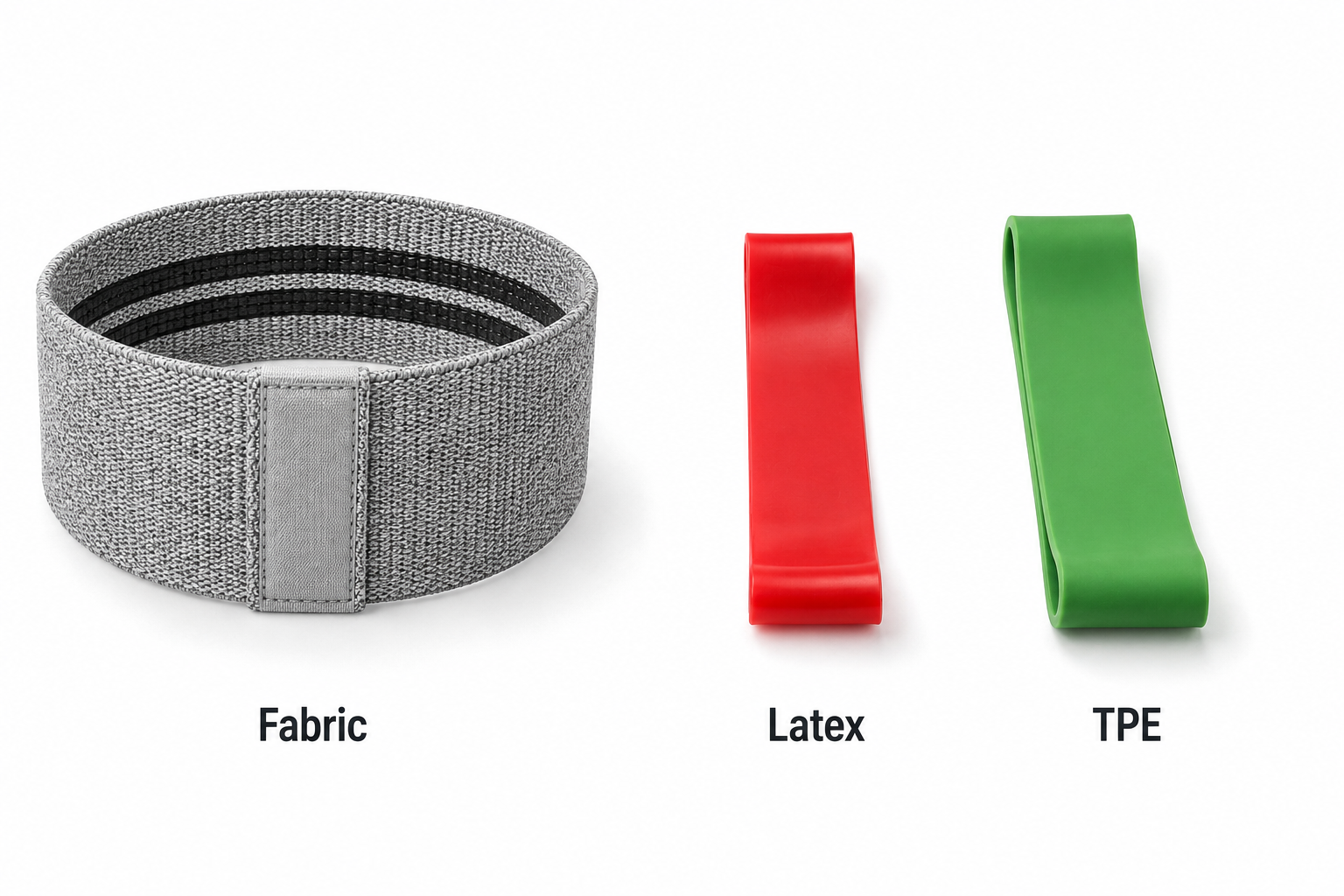
What Are Fabric Booty Bands?
Fabric booty bands (also called cloth hip bands, woven resistance bands, or fabric hip circles) are short-loop resistance bands made from a woven textile exterior with an internal elastic core. The typical construction is a polyester-cotton blend outer layer (for grip and comfort) with 2-4 strips of natural latex or TPE elastic sewn inside (for resistance). Some premium versions add a silicone grip strip on the inner surface for extra anti-slip performance.
The key dimensions for a standard fabric booty band: 13-16 inches circumference (flat length 6.5-8 inches), 3-4 inches wide, and they come in 3-4 resistance levels. Unlike smooth rubber or TPE mini loops, fabric bands have a limited stretch range of 50-80% — meaning a 14-inch band stretches to roughly 21-25 inches maximum. This lower stretch range is by design: it provides consistent tension without requiring the band to elongate dramatically.
Fabric bands exploded in popularity around 2019-2020, driven by Instagram and TikTok fitness influencers showcasing glute workouts. The market has grown rapidly, with Amazon search volume for "fabric booty bands" reaching approximately 480 searches per month and "hip resistance band" at 390/month as of 2026. They have carved out a distinct niche from traditional latex mini loops by solving the biggest complaint about rubber bands: rolling up during exercise.
Head-to-Head: Fabric vs Latex vs TPE Booty Bands
| Property | Fabric | Latex | TPE |
|---|---|---|---|
| Roll-Up Resistance | Excellent — stays flat | Poor — rolls and bunches | Good — smoother surface helps |
| Stretch Range | 50-80% | 300-600% | 300-500% |
| Resistance Levels | 3-4 levels typical | 5-8 levels | 5-8 levels |
| Skin Comfort | Very comfortable (textile) | Can be sticky/tacky | Smooth, non-tacky |
| Allergy Risk | Low (but internal elastic may be latex) | High (1-6% of population) | None — 100% synthetic |
| Durability | 6-18 months (elastic degrades, fabric frays) | 12-18 months | 24-36 months (10,000+ cycles) |
| Washability | Machine wash cold, air dry | Wipe with damp cloth | Wash with soap and water, quick dry |
| Odor | Can absorb sweat over time | Strong rubber smell initially | Odorless |
| Price (Retail, 3-band set) | $14-22 | $8-14 | $10-18 |
| Price (Wholesale FOB, per set) | $3.50-5.50 | $1.20-2.50 | $1.80-3.20 |
| Best For | Heavy glute work, home gym | Budget buyers, PT clinics | All-purpose, brands, gyms |
| Worst For | Upper body, high-stretch exercises | Bare-skin exercises, allergy-prone | Users wanting fabric feel |
The Rolling Problem: Why People Switch to Fabric
The number one complaint about latex and TPE mini loop bands during glute exercises is rolling. When you place a flat band around your thighs and perform movements like squats, hip thrusts, or lateral walks, the band tends to fold in on itself and roll into a narrow rope. This happens because:
Physics of rolling: A flat elastic band under tension naturally wants to minimize its surface area in contact with the skin. As your thigh muscles contract and relax through a movement, the skin slides against the smooth band surface. The friction is uneven across the band's width (higher at the edges, lower in the center), which creates a rolling torque. Wider bands roll less than narrow bands, but even a 3-inch flat band will roll during intense lower-body exercises.
Fabric bands solve this almost completely. The textile exterior creates multidirectional frictionagainst the skin — the woven fibers grip in every direction, preventing the band from folding. Premium fabric bands add silicone grip dots or strips on the inside surface, creating enough friction to stay flat even during heavy banded squats at 200+ lbs.
TPE bands are a middle ground. While they do not have the fabric grip, TPE's surface is smoother and less tacky than latex, which paradoxically reduces rolling — the band slides slightly against the skin rather than gripping unevenly and folding. A wider TPE band (2.5-3 inches) with a light powder coating performs significantly better than a narrow (1-2 inch) latex band. For the full material comparison, read ourTPE vs latex guide.
Stretch Range and Resistance: Where Fabric Falls Short
Fabric bands have one significant limitation: low stretch range. At 50-80% maximum elongation, a fabric band offers roughly one-fifth the stretch of a latex or TPE band. This means:
Fewer resistance levels: Most fabric bands come in only 3-4 levels (light, medium, heavy, extra-heavy) because the narrow stretch range limits how much you can differentiate between levels. TPE and latex bands can offer 5-8 distinct levels because their wider stretch range allows finer graduation.
Size sensitivity: Because fabric bands do not stretch far, the band circumference must closely match the user's thigh circumference. A person with 22-inch thighs needs a different size than someone with 28-inch thighs. Many fabric band brands now offer S/M/L sizing — an extra complexity for both consumers and wholesale buyers that does not exist with high-stretch TPE or latex bands.
Stretch Range Comparison (12" Band, Resting Length)
Fabric Band: Stretches to 18-21 inches (50-80%). Resistance feels constant throughout the movement. Limited range of motion before band maxes out.
Latex Band: Stretches to 48-84 inches (300-600%). Resistance increases progressively. Can accommodate any body size and a wide range of movements.
TPE Band: Stretches to 48-72 inches (300-500%). Similar progressive resistance to latex. Smooth, linear pull curve. Accommodates all body sizes.
The practical impact: If you only do banded glute exercises (hip thrusts, clamshells, lateral walks), fabric's limited stretch is not a problem — those exercises require only 20-40% band elongation. But if you also want to use the band for standing kickbacks, ankle-wrapped exercises, or any movement requiring significant stretch, fabric bands will restrict your range of motion. TPE bands handle both scenarios.
Allergy Safety: Why Material Matters for Skin Contact
Booty bands sit directly against bare skin — often on the inner thighs, one of the body's more sensitive areas. During exercise, sweat increases skin permeability, making allergen absorption more likely. This makes material choice a genuine safety consideration, not just a preference.
Latex allergy risk: Natural latex contains Hev b proteins (13 identified allergens) that can trigger Type I (immediate, potentially anaphylactic) or Type IV (delayed contact dermatitis) reactions. The incidence is 1-6% in the general population and up to 17% among healthcare workers with repeated exposure. Symptoms from latex band contact on thighs range from redness and itching (most common) to hives extending beyond the contact area (less common but significant).
Fabric band caveat: Many fabric bands use natural latex elastic inside the woven shell. Unless the product specifically states "latex-free fabric band," the internal elastic may be latex. The fabric barrier reduces direct skin contact with the latex, but does not eliminate allergen transfer entirely — especially when sweat wets the fabric and draws allergens through the weave.
TPE: zero allergy risk. TPE is a completely synthetic material from a different chemical family than natural rubber. It contains zero Hev b proteins, zero latex allergens. For gyms, schools, clinics, and any setting where you cannot screen users for latex sensitivity, TPE is the safest material.Read our complete latex-free resistance bands guide.
Hip Resistance Band Exercises: Top 5 Glute Activation Moves
Regardless of which material you choose, these five exercises form the core of any effective booty band workout. We have noted the best band placement and material for each:
1. Banded Glute Bridge
Band placement: Just above the knees. Target: Gluteus maximus, gluteus medius.Reps: 3 sets of 15-20. Resistance: Medium (15-25 lbs).
Lie on your back, feet flat on the floor hip-width apart, band around lower thighs. Drive hips upward while pressing knees outward against the band. Squeeze glutes hard at the top for 2 seconds. The outward knee pressure against the band forces the gluteus medius to fire alongside the maximus — turning a standard bridge into a complete glute exercise.
Best material: Any — low movement, minimal rolling risk.
2. Lateral Band Walk (Monster Walk)
Band placement: Just above the ankles or below the knees. Target: Gluteus medius, tensor fasciae latae. Reps: 3 sets of 12 steps per direction. Resistance:Light to medium (10-20 lbs).
Stand in a quarter-squat position, feet hip-width apart. Step laterally with the lead foot, then follow with the trailing foot — maintaining constant tension on the band. Keep toes forward (not turned out) and hips low. This exercise is the gold standard for gluteus medius activation and is used in nearly every physical therapy ACL rehabilitation protocol.
Best material: Fabric (anti-roll) or TPE (if placed above knees where rolling is less of an issue).
3. Banded Clamshell
Band placement: Just above the knees. Target: Gluteus medius, external rotators.Reps: 3 sets of 15 per side. Resistance: Light to medium (10-20 lbs).
Lie on your side, knees bent 90 degrees, feet together. Keeping feet touching, rotate the top knee upward against the band resistance, like opening a clamshell. Pause at the top for 1-2 seconds. Do not let the hips roll backward — this is the most common form error. Research shows clamshells with a band produce significantly higher glute medius EMG activation than bodyweight clamshells.
Best material: Any — band stays in place during this exercise regardless of material.
4. Banded Squat
Band placement: Just above the knees. Target: Glutes, quads, adductors.Reps: 3 sets of 12-15. Resistance: Medium to heavy (20-35 lbs).
Stand with feet shoulder-width apart, band around lower thighs. Squat down while actively pushing knees outward against the band. This cue — "push the knees out" — activates the glutes more than a standard squat and also helps correct the common form error of knee valgus (knees caving inward). Banded squats are used both as a standalone exercise and as a warm-up set before heavy barbell squats.
Best material: Fabric (highest rolling resistance during deep squats) or wide TPE (2.5-3 inches).
5. Banded Fire Hydrant
Band placement: Just above the knees. Target: Gluteus medius, hip abductors.Reps: 3 sets of 15 per side. Resistance: Light to medium (10-20 lbs).
Start on all fours, knees under hips, hands under shoulders. Keeping the knee bent at 90 degrees, lift one leg out to the side against the band — like a dog at a fire hydrant. Pause at the top, squeeze the glute, and lower slowly. Keep the core braced to prevent the hips from shifting — the movement should come entirely from the hip joint. This is one of the highest-activation exercises for the gluteus medius.
Best material: TPE or fabric — both work well; latex tends to pinch during the rotation.
For a complete breakdown of resistance levels for each exercise and how to build progressive workout programs, check our resistance band weight guide.
Durability: Which Material Lasts Longest?
Durability is where the three materials diverge significantly, and it matters for both individual buyers (replacement frequency) and wholesale buyers (return rates and customer satisfaction).
Durability Testing Results (Booty Band, 200% Elongation Where Applicable)
Fabric: Internal elastic degrades after 3,000-8,000 stretch cycles. Fabric exterior frays at stress points after 6-12 months of regular use. Elastic-to-fabric stitching is the common failure point. Machine washing accelerates degradation. Average useful life: 6-18 months.
Latex: Maintains resistance through approximately 15,000-20,000 cycles. Surface becomes tacky and powdery over time. UV exposure causes surface cracking within 6-12 months. Snapping risk increases after 12 months. Average useful life: 12-18 months.
TPE (TAICLET): Less than 5% resistance loss after 10,000+ cycles. No surface degradation, no tackiness, no powdering. UV-stabilized formula resists cracking in sunlit gyms. Average useful life: 24-36 months with daily use.
The durability gap matters for wholesale economics. Fabric bands have the highest return rate in the booty band category — approximately 8-12% on Amazon — primarily due to elastic breakage or stitching failure within the first 3-6 months. Latex bands return at about 4-6%, mostly from snapping. TPE bands have the lowest return rate at 1-3%.
For individual buyers, the cost-per-use calculation favors TPE: a $15 TPE band lasting 30 months costs $0.50/month. A $20 fabric band lasting 12 months costs $1.67/month. A $10 latex band lasting 15 months costs $0.67/month. TPE is cheapest per use despite being mid-range in purchase price.
Wholesale & B2B: Fabric vs TPE Profit Analysis
For wholesale buyers, brand owners, and Amazon sellers, the material choice has direct implications for margins, return rates, and brand positioning. Here is the real economics:
TPE Booty Bands (Economics)
- ✓ FOB cost: $1.80-3.20/set of 5
- ✓ Retail price: $12.99-17.99
- ✓ Gross margin: 75-85%
- ✓ Return rate: 1-3%
- ✓ "Latex-free" premium positioning
- ✓ Custom Pantone colors available
- ✓ 5-8 resistance levels in one SKU family
Fabric Booty Bands (Economics)
- ✓ FOB cost: $3.50-5.50/set of 3
- ✓ Retail price: $16.99-24.99
- ✓ Gross margin: 65-78%
- ✓ Return rate: 8-12%
- ✓ "Premium" positioning
- ✓ Custom colors/patterns possible
- ✓ Only 3-4 resistance levels
The margin story is clear: TPE booty bands deliver higher gross margins (75-85% vs 65-78%), lower return rates (1-3% vs 8-12%), and more SKU flexibility (5-8 levels vs 3-4). Fabric bands command higher retail prices but the higher FOB cost, higher return rate, and lower customer lifetime value (shorter product lifespan) erode the apparent premium.
The smart play for brand owners: Offer both. Stock TPE mini loops as your core product line (higher volume, better margins, broader appeal) and fabric bands as a premium upsell for the glute-focused audience. This is the configuration most top-selling Amazon resistance band brands use.See TAICLET wholesale pricing.
TAICLET Mini Loop Bands: The TPE Advantage for Glute Workouts
TAICLET's mini loop bandsare made from our proprietary TPE compound — formulated and produced in-house from raw SEBS pellets. For booty band applications specifically, our TPE formula offers several advantages:
Anti-roll design: Our mini loops are 2 inches wide (wider than many competitors at 1.5 inches) and use a light matte surface finish that reduces rolling without adding tackiness. The wider profile distributes force more evenly across the thigh, which both reduces rolling torque and increases comfort.
7 resistance levels: From 5 lbs (pink, X-light) to 50 lbs (grey, XX-heavy), our 7-color system covers the full range needed for both rehabilitation and advanced strength training. Most fabric bands top out at "heavy" (roughly 25-30 lbs equivalent) — our system goes to 50 lbs for athletes who need serious resistance. Check our color code chart for the exact resistance at each level.
Zero allergy risk: Unlike fabric bands that may contain latex elastic inside, TAICLET TPE bands are 100% latex-free through every layer. There is no hidden latex — the entire band is one continuous piece of extruded TPE. Safe for bare skin contact even during sweaty workouts.
Custom branding: Available in any Pantone color, with screen-printed or heat-transfer logos. MOQ 500 pieces per size per color. Samples delivered in 3-5 days. Because we control the TPE pellet formulation, color consistency across batches is guaranteed within Delta E 1.5 (visually identical).
The Verdict: Which Should You Choose?
Choose Fabric If:
- ✓ Heavy squats/thrusts are your primary use
- ✓ Rolling is your biggest frustration
- ✓ You prefer the textile feel on skin
- ✓ You only need 3-4 resistance levels
Skip Latex If:
- × Using on bare skin (allergy risk)
- × Selling to gyms/schools (liability)
- × Brand reputation matters (rolling complaints)
- × Need consistent color across batches
Choose TPE If:
- ✓ You want the most versatile option
- ✓ Zero allergy risk is important
- ✓ You need 5-8 resistance levels
- ✓ Best durability and lowest returns
For most people, TPE is the best all-around choice. It handles every exercise type, lasts the longest, has zero allergy risk, and offers the widest range of resistance levels. Fabric is a solid specialist choice for dedicated glute training. Latex is the budget option, but the rolling, allergy, and durability issues make it hard to recommend for bare-skin booty band use.
For wholesale and brand buyers: the data shows TPE delivers better economics (higher margin, lower returns, longer customer lifespan) while fabric offers premium positioning for a niche audience. The ideal product line includes both — TPE as the core, fabric as the premium upsell.
About the Author
This guide was written by the TAICLET technical and product team. We manufacture TPE mini loop bands from in-house compounded pellets, giving us direct insight into material performance, production economics, and quality control. We also test competitor fabric and latex bands for ongoing benchmarking.Learn more about TAICLET.
Related Resources
- TPE vs Latex Resistance Bands: The Definitive Comparison— Deep dive into material science, allergy data, and factory test results.
- Resistance Band Color Code Chart: What Each Color Means— Complete color-to-resistance mapping for TheraBand, SPRI, and generic bands.
- Resistance Band Weight Guide: How to Choose the Right Level— Match resistance to specific exercises and fitness goals.
- TAICLET Mini Loop Bands (TPE)— 7 colors, 5-50 lbs, latex-free, custom branding available.
- Fabric vs TPE vs Latex: Complete Material Comparison— Broader comparison covering all resistance band types, not just booty bands.
- Get Custom Bands with Your Logo — OEM/ODM from 200 sets, Pantone matching, retail packaging.
- Wholesale Pricing & MOQ — Factory-direct tiered pricing for all band types.
- Request a Free Quote — Samples in 3-5 days, 12-hour response time.